TL;DR
The Architecture Content Framework structures the architecture work products created during ADM. It defines the artifacts and deliverables that may be developed to describe the architecture, while the actual results are stored in the Architecture Repository.
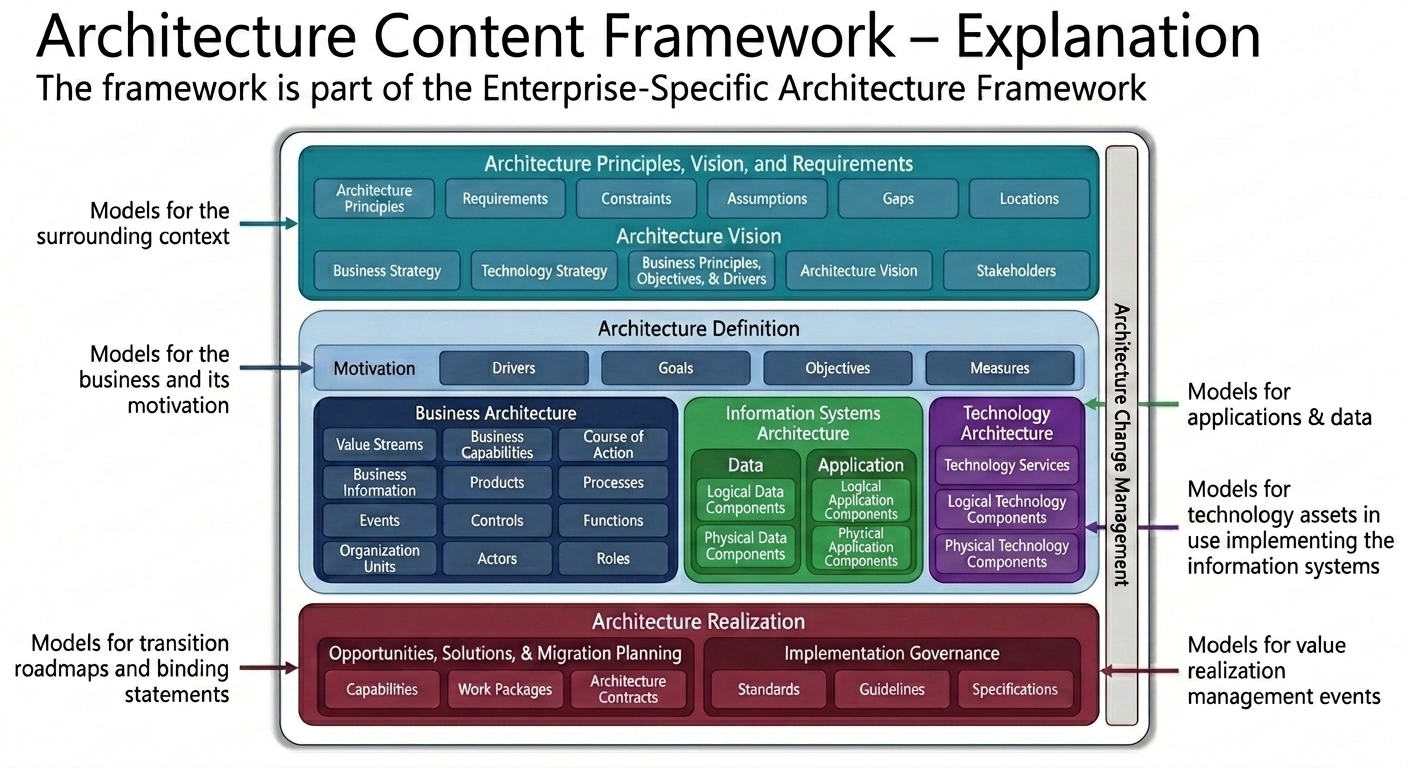
What it is
The Architecture Content Framework is a core concept in the TOGAF Standard.
When you develop an enterprise architecture with the ADM, you create architecture work products in every phase.
The content framework helps answer:
Which work products, facts, models, artifacts, and descriptions should be developed?
It is a categorization framework for structuring architecture descriptions, work products, artifacts, and models.
Purpose
The content framework defines the artifacts and work products that can be developed to describe the architecture.
It provides an underlying structure and companion for the ADM.
The top-level structure of the content framework mirrors the ADM phases.
It also puts each deliverable into the context of the holistic architecture view of the enterprise.
Content framework vs repository
The content framework describes which work products should be developed.
It does not store the actual work results.
For example, the framework may show that value streams and business capabilities are used to describe the Business Architecture.
But the actual value streams and business capabilities developed by the architecture team are stored in the Architecture Repository.
In simple terms:
| Concept | Role |
|---|---|
| Architecture Content Framework | defines and categorizes the work products used to describe architecture |
| Architecture Repository | stores the actual architecture work products and reusable assets |
Alternative content frameworks
There are many possible architecture content frameworks.
Examples include:
- TOGAF Content Framework
- Segment Architecture Framework
- DoDAF
- NATO Architecture Framework
Selecting a content framework is important, but the specific choice is usually less important than adapting it to fit the organization’s needs.
Most enterprises tailor the final content framework for their own context.
TOGAF content framework structure
The TOGAF Content Framework is organized around major architecture content areas that correspond to ADM concerns.
Architecture principles, vision, and requirements
The top area includes architecture principles, vision, and requirements.
It corresponds broadly to:
- Preliminary Phase
- Phase A: Architecture Vision
- Requirements Management
Examples include architecture principles, architecture requirements, and the Architecture Vision.
Architecture definition
The architecture definition area includes the core architecture description.
It corresponds broadly to:
Examples include business capabilities, value streams, data artifacts, application artifacts, and technology artifacts.
Architecture realization
The architecture realization area focuses on turning architecture definition into delivery.
It corresponds broadly to:
Examples include opportunities and solutions, migration planning, implementation governance, work packages, and roadmap-related content.
Architecture change management
Phase H: Architecture Change Management surrounds or affects the other content areas.
This reflects the fact that architecture change management can affect principles, requirements, architecture definition, and architecture realization.
Benefits
The Architecture Content Framework provides several benefits.
It helps:
- provide a detailed model of architectural work products
- drive consistency in ADM outputs
- act as a checklist of possible architecture outputs
- reduce the risk of gaps in the final deliverable set
- standardize architecture concepts, terms, and deliverables
- connect individual deliverables to a holistic enterprise architecture view
Exam note
- The Architecture Content Framework is a core TOGAF concept.
- It defines the artifacts and work products used to describe architecture.
- It structures architecture descriptions, work products, artifacts, and models.
- Its top-level structure mirrors ADM phases.
- It is a companion structure for ADM.
- The content framework identifies what should be developed; the Architecture Repository stores the actual results.
- Examples of content frameworks include the TOGAF Content Framework, DoDAF, and the NATO Architecture Framework.
- The selected content framework is usually tailored to fit the organization’s needs.
- Benefits include consistency, reduced gaps, standard terminology, and a checklist of possible outputs.