TL;DR
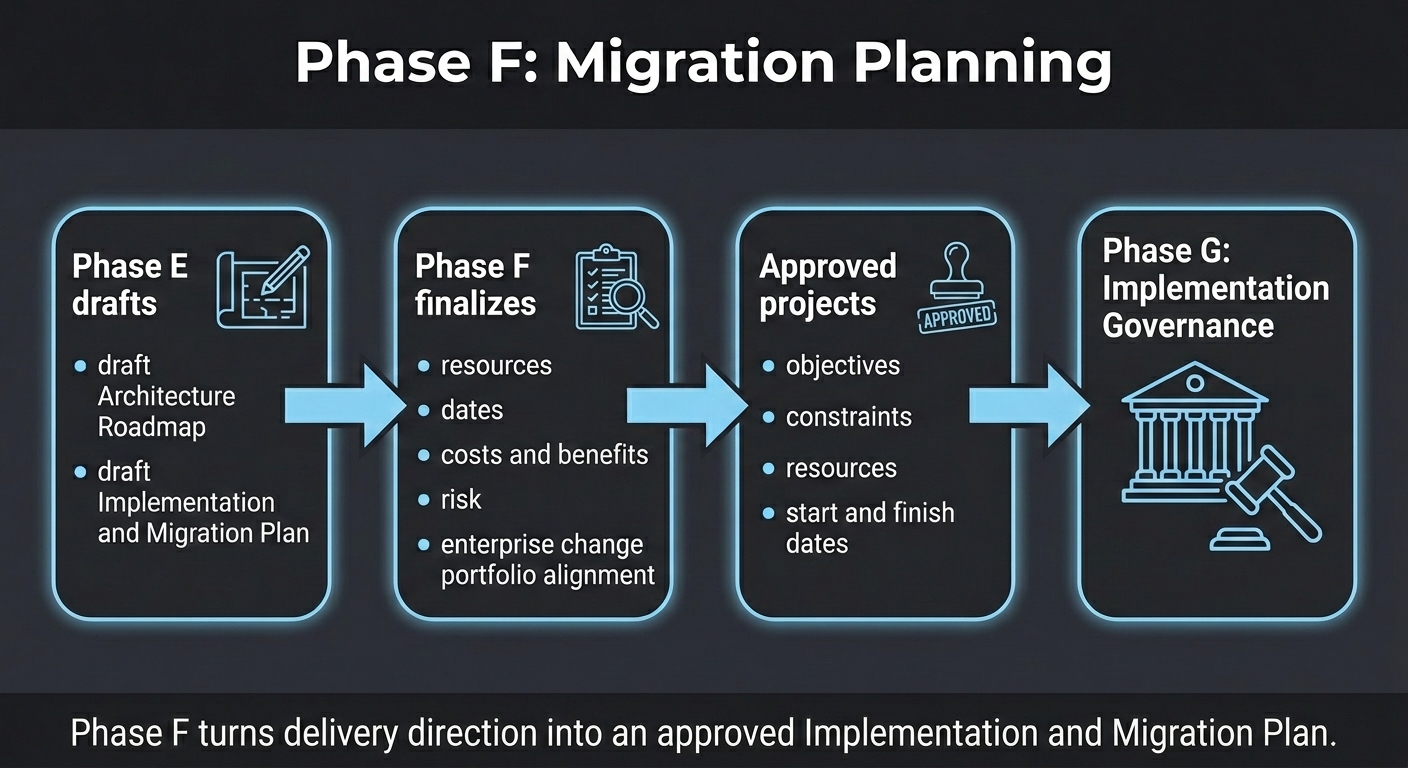
Phase F finalizes the Implementation and Migration Plan that was initiated in Phase E. It turns the delivery direction into an approved set of projects with objectives, constraints, resources, and dates.
Where Phase F sits
Phase E identifies the opportunities and solution direction. It creates the initial Architecture Roadmap and starts the Implementation and Migration Plan.
Phase F picks up that plan and finalizes it.
The central question is:
How will the enterprise move from the baseline architecture to the target architecture?
Purpose
The purpose of Phase F is to finalize a detailed Implementation and Migration Plan for moving from baseline to target architectures.
Phase F also estimates the resources required to undertake the change and checks that those resources can be made available.
As in Phase E, stakeholder priorities should be managed using:
- business value
- effort
- risk
- cost
- delivery constraints
The plan should make the trade-offs visible enough for stakeholders to understand what will be delivered, when it will be delivered, and what it will require.
Main output and outcome
The main outcome of Phase F is an approved set of projects.
Each project should contain:
- objective
- necessary constraints
- required resources
- start date
- finish date
In this context, a project is simply an organizing unit for work that achieves an understood outcome. The exact organizational definition of a project may vary.
Objectives
Phase F has three main objectives.
- Finalize the Architecture Roadmap and the supporting Implementation and Migration Plan.
- Coordinate the Implementation and Migration Plan with the enterprise’s approach for managing and implementing change across the overall change portfolio.
- Ensure key stakeholders understand the business value and cost of work packages and transition architectures.
What Phase F adds
Phase E creates the delivery shape. Phase F turns that shape into approved migration planning.
| Phase | Focus |
|---|---|
| Phase E: Opportunities and Solutions | identifies work packages, transition architectures, delivery vehicles, and the initial plan |
| Phase F: Migration Planning | finalizes the roadmap and plan, coordinates with enterprise change planning, and confirms resources and dates |
Phase F is therefore less about discovering the target architecture and more about making delivery decisions concrete.
Exam note
- Phase F is Migration Planning.
- Phase F finalizes the Implementation and Migration Plan initiated in Phase E.
- It answers how to move from baseline to target architectures.
- It estimates required resources and checks their availability.
- The main outcome is an approved set of projects with objectives, constraints, resources, and start and finish dates.
- Phase F finalizes the Architecture Roadmap and supporting Implementation and Migration Plan.
- It coordinates the plan with the enterprise change portfolio.
- It communicates business value and cost of work packages and transition architectures to key stakeholders.