TL;DR
Phase G provides architectural oversight while implementation projects deliver the approved target architecture, or incremental progress toward it. The Enterprise Architect governs conformance, guides implementation teams, and manages architecture change requests that arise during delivery.
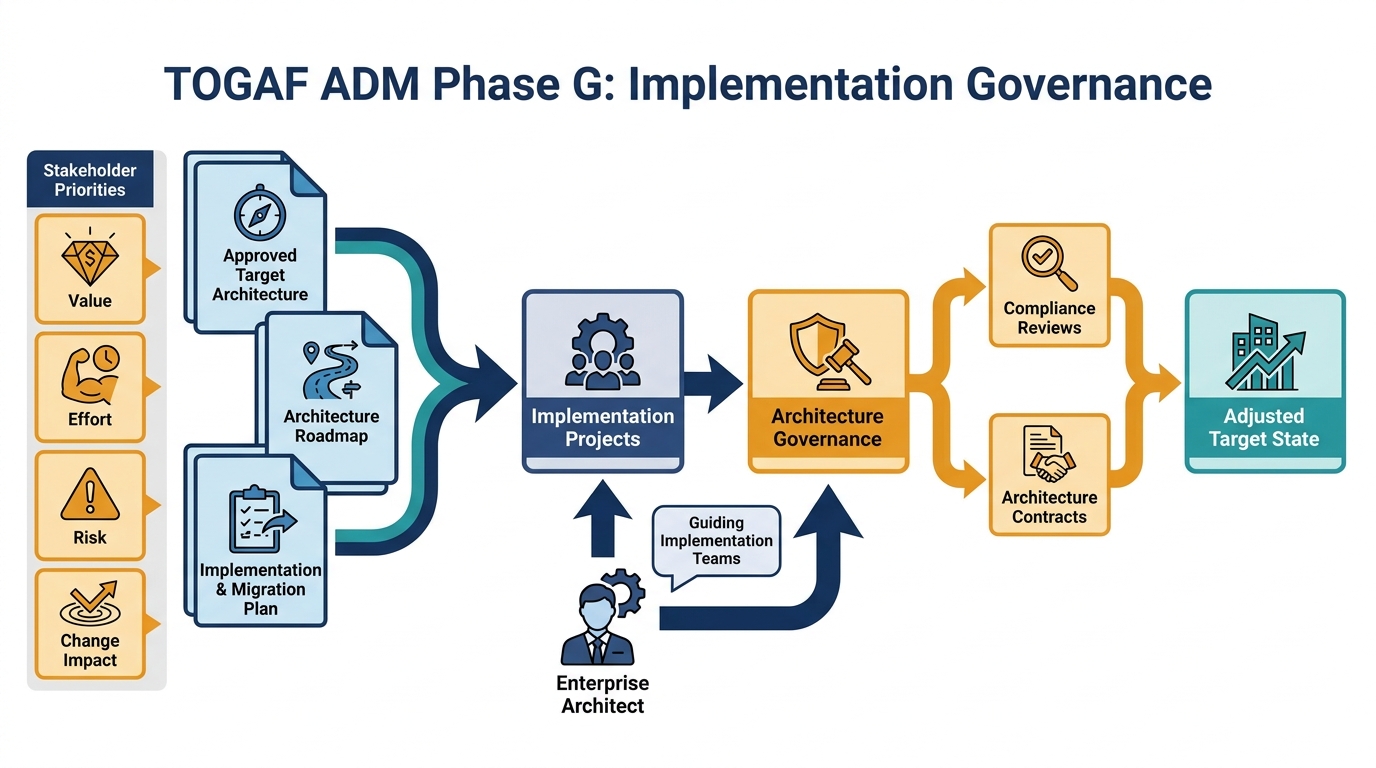
Where Phase G sits
By the start of Phase G, the target architectures have been approved.
The Architecture Roadmap and the Implementation and Migration Plan have also been finalized.
Now implementation projects begin delivering the target architecture step by step, or at least delivering increments toward the target state.
Purpose
The purpose of Phase G is to provide architecture oversight during implementation.
This means ensuring that implementation projects conform to the defined architectures and that governance functions are applied while solutions are being built.
Phase G also guides the implementation teams by clarifying:
- the purpose of each implementation team
- the constraints each team must work within
- the gaps each team is responsible for closing
- the architectural expectations for their delivery work
Managing stakeholder priorities
As implementation progresses, stakeholder preferences may change.
This can happen because delivery succeeds, fails, takes more effort than expected, creates new risks, or reveals different business value.
The Enterprise Architect must continue managing stakeholder priorities and preferences against:
- success
- value
- effort
- risk
- change impact
Phase G is therefore not passive supervision. It is active governance while the architecture becomes real through implementation.
Main output and outcome
The outcome of Phase G is the completion of implementation projects that deliver the changes needed to reach the adjusted target state.
The target state may be adjusted as implementation-driven change requests are assessed and governed.
Objectives
Phase G has two main objectives.
- Ensure the conformance of implementation projects with the target architecture.
- Perform appropriate architecture governance functions for the solution and for any implementation-driven architecture change requests.
Exam note
- Phase G is Implementation Governance.
- It begins after the target architectures, Architecture Roadmap, and Implementation and Migration Plan are approved.
- It provides architectural oversight of implementation projects.
- It ensures implementation project conformance with the target architecture.
- It guides implementation teams by defining purpose, constraints, and gap ownership.
- Stakeholder priorities may change during implementation and must be actively managed.
- Implementation-driven architecture change requests are handled through architecture governance.
- The outcome is completed implementation work that moves the enterprise toward the adjusted target state.