TL;DR
Phase E is the first ADM phase that deals directly with solutions and implementation. It turns the target architectures from Phases B-D into solution options, work packages, delivery vehicles, and an initial complete Architecture Roadmap.
At a glance, Phase E moves from architecture definition to delivery planning.
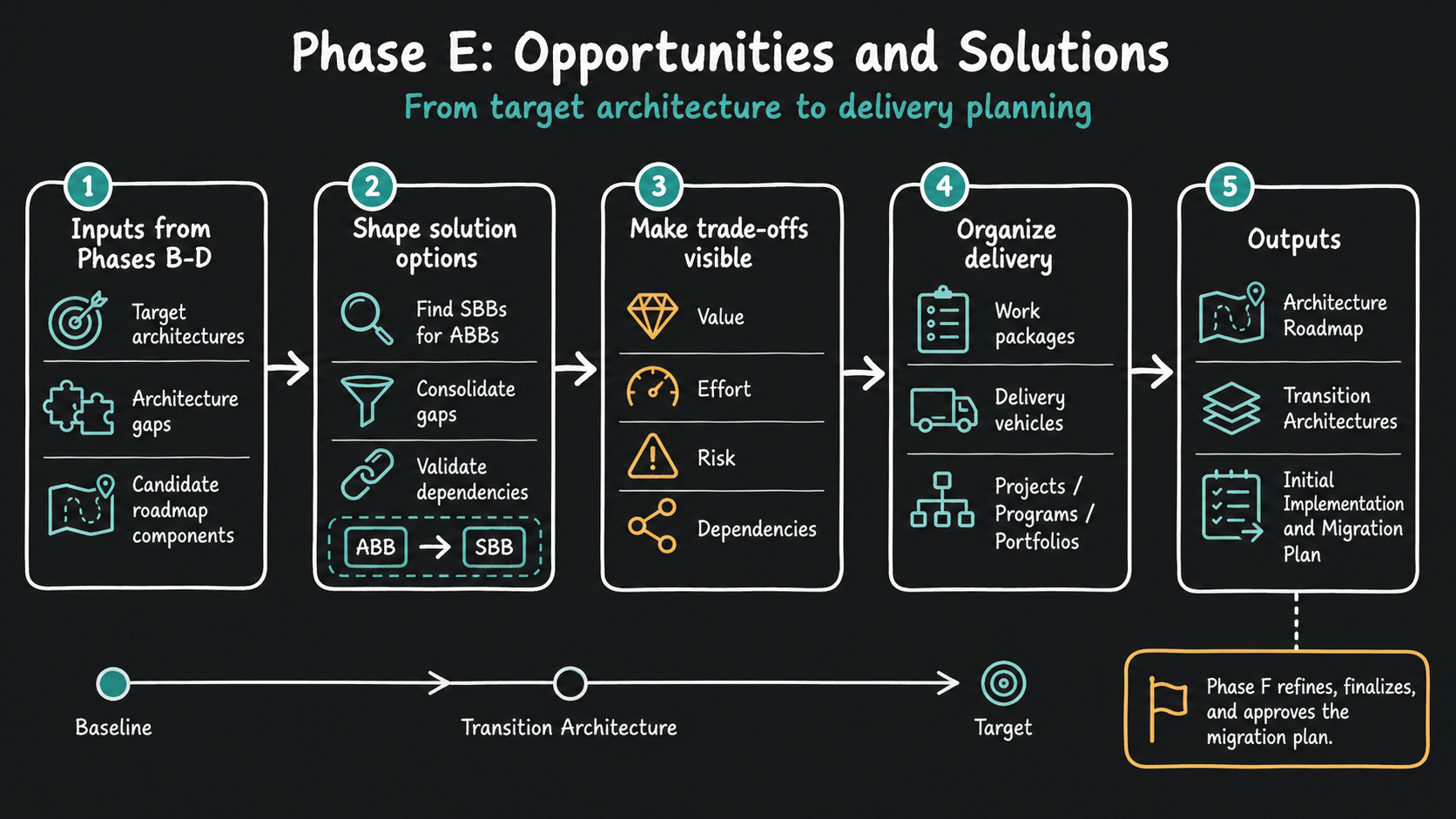
Where Phase E sits
By the end of Phases B, C, and D, the target architecture has been developed across:
- Business Architecture
- Data Architecture
- Application Architecture
- Technology Architecture
At this point, the target architecture is often still solution-independent. It is described through Architecture Building Blocks that define required capabilities and specifications.
Phase E starts asking how the target architecture will be delivered.
For the detailed activity flow, see Steps. For the closing delivery summary, see Approach.
Purpose
Phase E identifies the solution approach for delivering the target architecture.
Solution Architecture
A description of a discrete and focused business operation or activity and how IS/IT supports that operation.
It focuses on:
- finding Solution Building Blocks (SBBs) that can implement Architecture Building Blocks (ABBs)
- conducting initial implementation planning
- validating work package and gap dependencies
- identifying delivery vehicles such as projects, programs, or portfolios
- understanding the value, effort, and risk of each change
In short, Phase E concentrates on how to deliver the architecture.
ABBs to SBBs
Phases B-D define what is needed. Phase E starts shaping how it can be delivered.
flowchart LR
    ABD["Architecture Building Blocks<br/>what capability is needed"]
    GAP["Gaps from Phases B-D"]
    SBB["Solution Building Blocks<br/>how capability may be implemented"]
    WP["Work Packages"]
    DV["Delivery Vehicles<br/>projects, programs, portfolios"]
    ROAD["Initial Architecture Roadmap"]

    ABD --> SBB
    GAP --> WP
    SBB --> WP
    WP --> DV
    DV --> ROAD
The important shift is from architecture definition to delivery planning.
Work packages and delivery vehicles
Phase E should make the delivery shape clearer.
Work Package
A set of actions identified to achieve one or more objectives for the business. A work package can be a part of a project, a complete project, or a program.
| Concept | Meaning |
|---|---|
| Work package | A set of work required to close architecture gaps and move toward the target architecture |
| Delivery vehicle | The project, program, or portfolio that will deliver one or more work packages |
| Architecture Roadmap | A structured view of the work needed to move from baseline to target architecture |
Phase E lists work packages and makes the delivery trade-offs visible. Stakeholders need to understand:
- dependencies between work packages
- value produced by each work package
- effort required
- delivery risk
- which delivery vehicle will realize the work
Once value, effort, and risk are visible, stakeholder priorities may change.
Objectives
Phase E has three core objectives.
- Generate the initial complete version of the Architecture Roadmap based on gap analysis and candidate Architecture Roadmap components from Phases B, C, and D.
- Determine whether an incremental approach is required. If it is, identify transition architectures that deliver continuous business value.
- Define the overall Solution Building Blocks needed to finalize the target architecture based on the Architecture Building Blocks.
Transition architectures
A transition architecture is an intermediate architecture state on the way to the target architecture.
It is useful when moving directly to the target architecture is:
- too risky
- too expensive
- too slow
- strategically impractical
- not possible in a single step
A good transition architecture provides real business benefit while moving the enterprise closer to the target.
Output and outcome
The practical outcome of Phase E is a more delivery-ready view of the architecture.
Expected outputs include:
- work packages that address architecture gaps
- dependencies between work packages
- delivery vehicles such as projects, programs, or portfolios
- indication of value produced
- indication of effort required
- initial complete Architecture Roadmap
- initial Implementation and Migration Plan
- candidate transition architectures, if needed
- Solution Building Blocks that help finalize the target architecture
Exam note
- Phase E is Opportunities and Solutions.
- It is the first ADM phase that directly deals with solutions and implementation.
- Phase E turns candidate roadmap components from Phases B-D into work packages and delivery options.
- Delivery vehicles are projects, programs, or portfolios.
- Phase E considers value, effort, risk, and dependencies.
- Transition architectures are intermediate states that deliver value on the way to the target.
- Phase E develops the initial complete Architecture Roadmap.