TL;DR
Requirements Management is the central ADM process that documents, evaluates, distributes, and manages architecture requirements. It runs continuously across the ADM cycle, keeps requirements traceable, and maintains the complete set of requirements as a single point of truth.
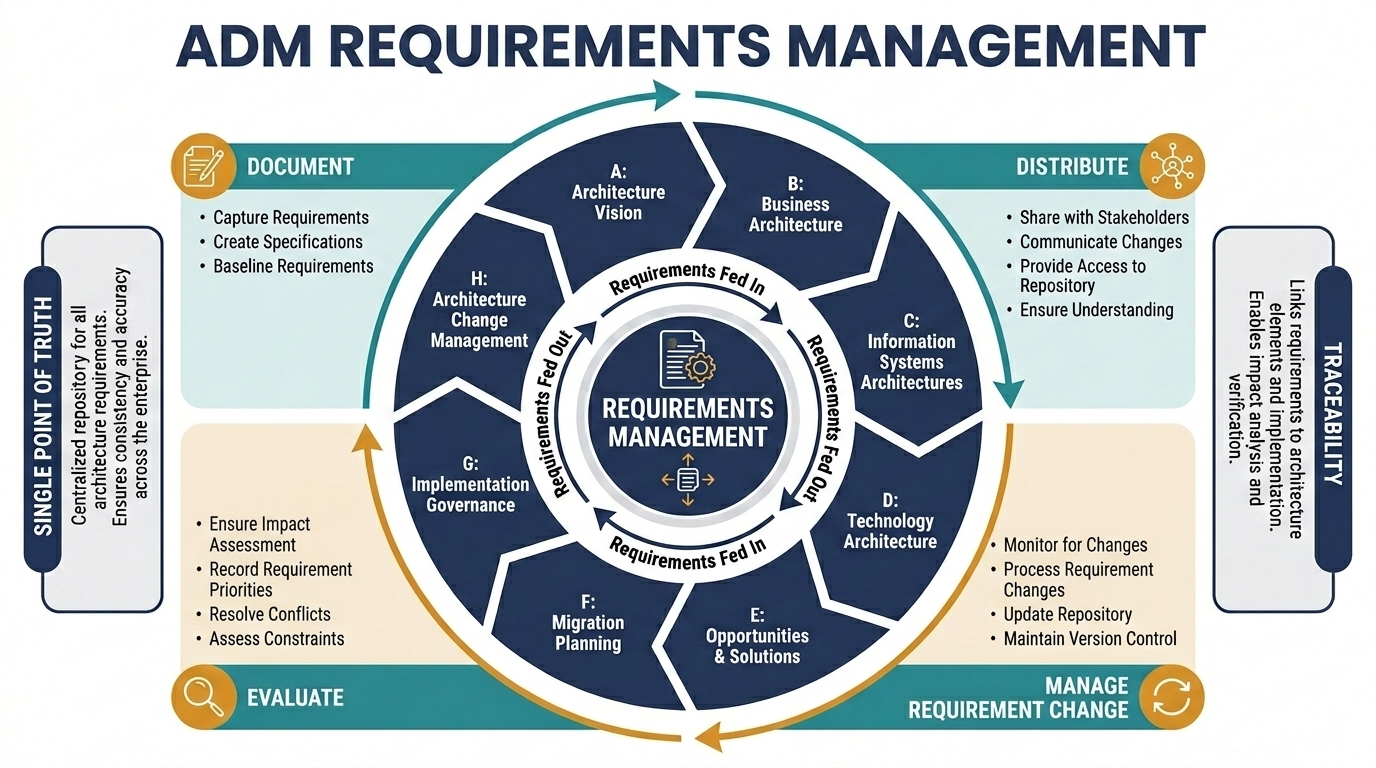
Where it sits
Requirements Management sits at the center of the ADM cycle.
Unlike the other ADM phases, it has no letter prefix.
It is connected with the lettered phases of the ADM cycle because requirements management runs continuously while architecture work is being performed.
This central position shows that requirements help drive the ADM.
Purpose
The Requirements Management phase documents, evaluates, and distributes architecture requirements.
Requirement
A statement of need which is unambiguous, testable or measurable, and necessary for acceptability.
Its main purpose is to manage architecture requirements throughout the ADM cycle.
For example, if a new requirement is identified during Phase C, the requirement is assessed through Requirements Management.
The Enterprise Architect then evaluates:
- the requirement itself
- the impact on the architecture
- whether the requirement can be integrated
- which ADM phases or deliverables may be affected
Managing requirement change
One of the main purposes of Requirements Management is to manage changing requirements.
Requirements can change because:
- new stakeholder concerns appear
- existing stakeholder preferences shift
- architecture work reveals new constraints
- business priorities change
- technology options change
- implementation learning creates new needs
Requirements Management provides the process for assessing and controlling those changes.
Operating the requirements process
Another purpose is to operate an effective process for managing architecture requirements.
This process should identify requirements, store them, and feed them into and out of the relevant ADM phases.
Requirements Management is therefore dynamic.
It does not simply record requirements once. It continuously manages requirements as the architecture develops.
Traceability
Effective requirements management depends on clear traceability.
Requirements should be traceable from high-level enterprise direction down to detailed architecture requirements.
Traceability should connect:
- vision
- mission
- business model
- strategy
- stakeholder concerns
- stakeholder preferences
- architecture requirements
- detailed requirement statements
This makes it easier to understand why a requirement exists and what would be affected if it changes.
Single point of truth
Many requirements arise during architecture development.
Requirements Management maintains the complete set of requirements as a single point of truth.
This includes stakeholder preferences as well as formal architecture requirements.
The goal is to avoid fragmented requirement lists across phases, teams, or deliverables.
Objectives
Requirements Management has three main objectives.
- Ensure that the requirements management process is sustained and operates for all relevant ADM phases.
- Manage architecture requirements identified during any execution of the ADM cycle or phase.
- Ensure that relevant architecture requirements are available for use by each ADM phase.
Exam note
- Requirements Management sits at the center of the ADM cycle.
- It has no letter prefix.
- It runs continuously during ADM execution.
- It documents, evaluates, and distributes architecture requirements.
- It manages architecture requirements throughout the ADM.
- It manages requirement change when new or changed requirements appear.
- It provides traceability from vision, mission, business model, and strategy down to detailed requirements.
- It maintains the complete requirements set as a single point of truth.
- It stores requirements and feeds them into and out of relevant ADM phases.
- Its three objectives are to sustain the requirements process, manage architecture requirements, and make relevant requirements available to each phase.