TL;DR
The Architecture Repository stores, manages, and reuses the architecture work products created through ADM. The Content Framework defines what kinds of work products should exist; the Architecture Repository stores the actual developed artifacts and assets.
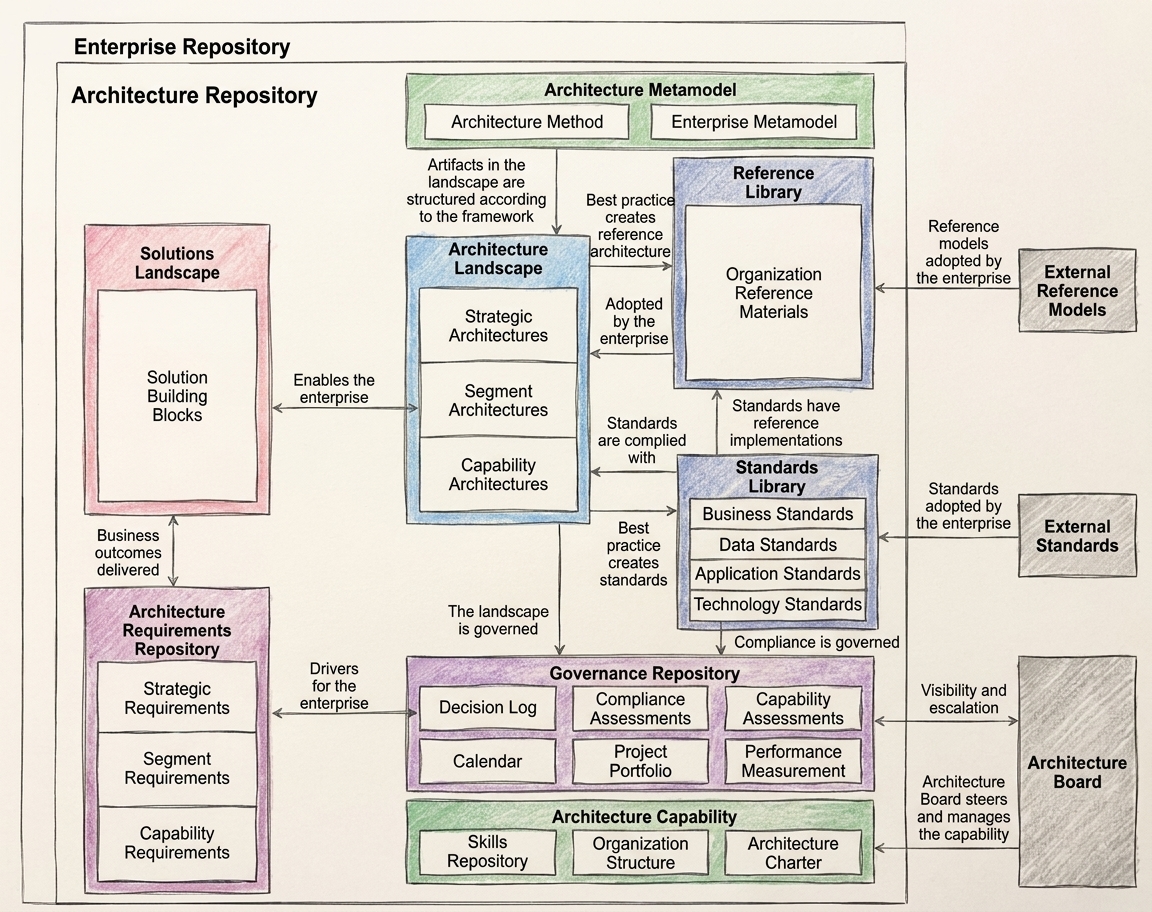
What it is
When you develop an enterprise architecture with the ADM, you create architecture work products in every phase.
The Architecture Repository is the place where those results are stored and managed.
It gives the enterprise a way to organize, reuse, govern, and find architecture assets over time.
This becomes especially important in large organizations where years of architecture work can create a large volume of models, documents, standards, decisions, requirements, and reusable assets.
Purpose
The Architecture Repository provides:
- storage for architecture work products
- a taxonomy for different types of architecture assets
- a way to manage assets at different levels of abstraction
- support for architecture governance
- a foundation for reuse across ADM cycles
- visibility into standards, requirements, decisions, and architecture landscapes
Initially, the repository can be understood as a structural framework.
Once physically implemented, it becomes the place where architecture work products are stored, maintained, and reused.
It may be implemented using:
- architecture modeling tools
- analytics tools
- file repositories
- document management systems
- knowledge management platforms
Repository vs content framework
The Architecture Content Framework defines the artifacts and work products used to describe an architecture.
The Architecture Repository stores the actual artifacts and work products developed by the architecture team.
In simple terms:
| Concept | Role |
|---|---|
| Architecture Content Framework | defines and categorizes the work products that should be created |
| Architecture Repository | stores, manages, and reuses the created work products and architecture assets |
For example, the content framework may identify that value streams, business capabilities, standards, requirements, and architecture contracts are useful work products.
The Architecture Repository stores the actual value streams, capability models, standards, requirements, and contracts produced for the enterprise.
Main repository areas
The TOGAF Architecture Repository distinguishes between several types of architecture assets.
Architecture Landscape
The Architecture Landscape stores architectural representations of assets deployed in the operating enterprise at a point in time.
It may exist at different levels of abstraction:
- strategic architectures
- segment architectures
- capability architectures
Strategic architectures are higher-level and broader in scope.
Capability architectures are usually more detailed and focused on a specific capability or change area.
Architecture Metamodel
The Architecture Metamodel area stores the organization-specific tailoring of the architecture framework.
This can include:
- the architecture method
- the enterprise metamodel
- rules for architecture content
- tailored definitions of architecture entities and relationships
This connects closely to the Enterprise Metamodel.
Architecture Capability
The Architecture Capability area stores the parameters, structures, and processes that support the governance and operation of the architecture capability.
Examples include:
- skills repository
- organization structure
- architecture charter
- governance structures
Standards Library
Standards Library
A library of standards that can be used to define the particular services and other components of an Organization-Specific Architecture.
The Standards Library captures standards that new architectures must comply with.
It may include:
- business standards
- data standards
- application standards
- technology standards
- selected supplier products and services
- shared services already deployed in the organization
Solutions Landscape
The Solutions Landscape stores architectural representations of solution building blocks.
Solution building blocks may be planned or already deployed by the enterprise.
They support the Architecture Landscape by showing the solutions used to implement required capabilities.
In simple terms:
- architecture building blocks describe what capability is needed
- solution building blocks describe how that capability is implemented
Reference Library
The Reference Library stores reusable reference material that can accelerate architecture development.
Viewpoint Library
A collection of the specifications of architecture viewpoints contained in the Reference Library portion of the Architecture Repository.
Examples include:
- guidelines
- templates
- patterns
- best practices
- reference architectures
- reference models
- viewpoint library
Architecture Requirements Repository
The Architecture Requirements Repository stores authorized architecture requirements agreed with the Architecture Board.
Requirements may be organized at different levels:
- strategic requirements
- segment requirements
- capability requirements
This repository provides a single source for architecture requirements across architecture work.
Governance Repository
The Governance Repository stores records of governance activity across the enterprise.
Examples include:
- decision logs
- compliance assessments
- capability assessments
- performance measurements
- calendars
- project portfolio information
This supports transparency, accountability, and governance traceability.
Exam note
- The Architecture Repository stores the outputs and assets created through ADM.
- The Content Framework defines what work products should be developed.
- The Architecture Repository stores the actual work products.
- The Architecture Landscape stores architecture descriptions at strategic, segment, and capability levels.
- The Architecture Metamodel stores the tailored architecture method and enterprise metamodel.
- The Architecture Capability area stores the structures and processes supporting the architecture capability.
- The Standards Library stores standards with which new architectures must comply.
- The Solutions Landscape stores solution building blocks.
- The Reference Library stores reusable reference materials such as templates, patterns, reference architectures, and viewpoints.
- The Architecture Requirements Repository stores authorized architecture requirements.
- The Governance Repository stores governance records such as decisions, assessments, and performance measures.