TL;DR
Phase C develops the Information Systems Architectures: Data Architecture and Application Architecture. These can be developed in either order or in parallel, and both must support the agreed Architecture Vision and the Business Architecture.
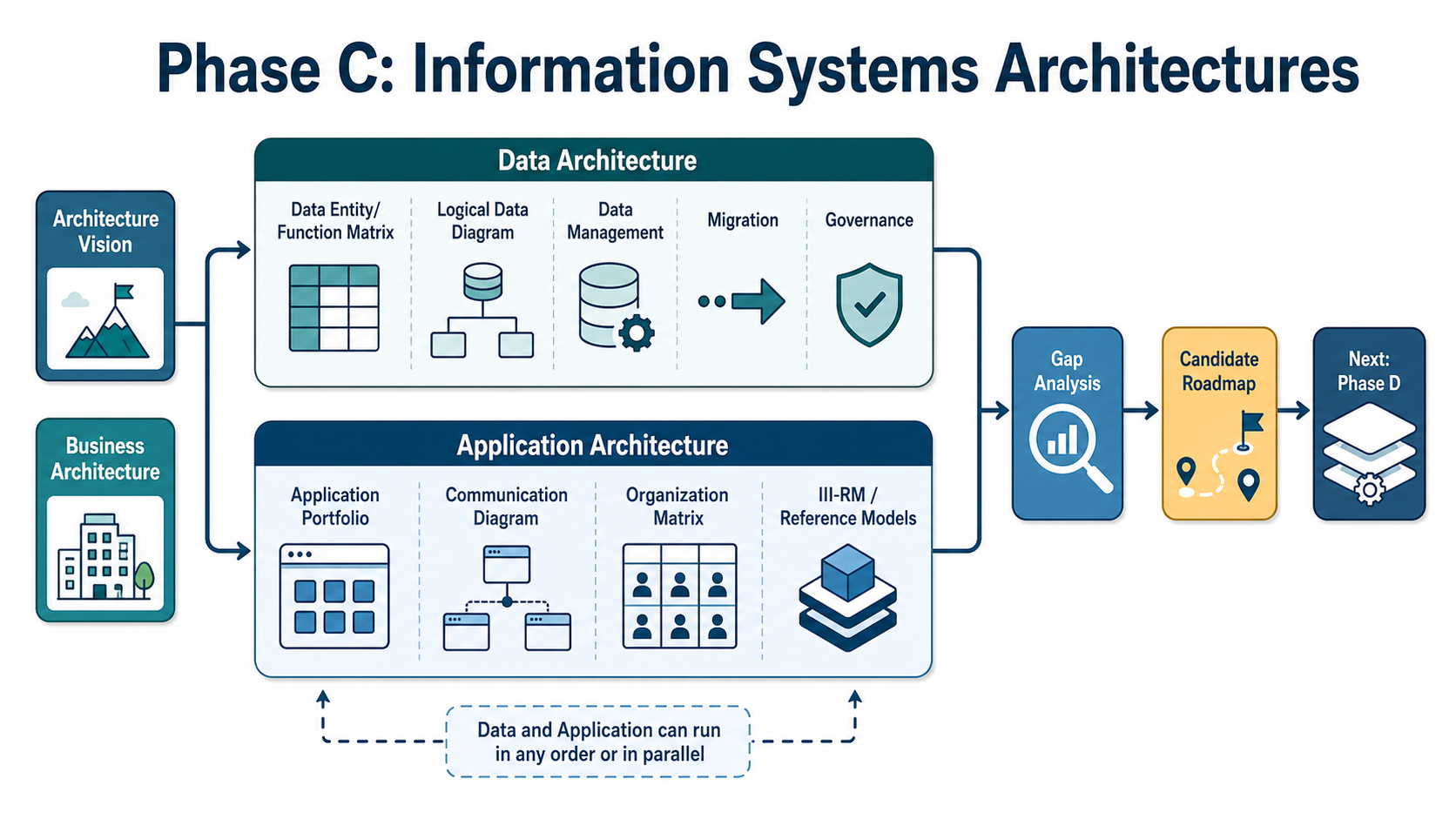
Where Phase C sits
Phase C is the second domain-architecture phase in the ADM cycle.
The domain sequence is:
- B — Business Architecture
- C — Information Systems Architectures
- D — Technology Architecture
Phase C covers the D and A in the common BDAT shorthand:
- D: Data Architecture
- A: Application Architecture
It is the only ADM phase split into two architecture parts.
Two parts of Phase C
| Part | Main question |
|---|---|
| Data Architecture | What data does the enterprise need, how is it structured, and how should it support the business? |
| Application Architecture | Which applications are needed, how do they interact, and how do they support business processes and data needs? |
The two parts may be developed:
- data first
- application first
- in parallel
The order depends on the architecture scope, available information, stakeholder concerns, and delivery context.
For practical development guidance, see Approach.
Purpose
Develop target Information Systems Architectures to support the agreed Architecture Vision.
This follows the same purpose pattern used in Phases B, C, and D:
- Phase B develops Business Architecture
- Phase C develops Information Systems Architectures
- Phase D develops Technology Architecture
Each domain architecture supports the agreed Architecture Vision.
Objectives
The objectives are the same for Data Architecture and Application Architecture.
- Develop the target Data and Application Architectures. Describe how the enterprise information systems will enable the Business Architecture and Architecture Vision in a way that addresses the Statement of Architecture Work and stakeholder concerns.
- Identify candidate Architecture Roadmap components based on gaps between the baseline and target Data and Application Architectures.
In short:
- develop Data and Application Architectures that support the Business Architecture
- identify candidate roadmap components from baseline-to-target gaps
Core flow
flowchart LR
    AV["Architecture Vision"] --> BA["Business Architecture"]
    BA --> DA["Data Architecture"]
    BA --> AA["Application Architecture"]
    DA --> GAP["Gap Analysis"]
    AA --> GAP
    GAP --> ARC["Candidate Architecture Roadmap Components"]
    ARC --> D["Proceed to Phase D"]
Typical artifacts
Phase C commonly produces artifacts related to data and applications, such as:
- data models
- data entity catalogs
- data lifecycle views
- interface diagrams
- application communication diagrams
- application landscape diagrams
- application portfolio views
A simple memory hook: if the architecture artifact is mainly about data or applications, it usually belongs in Phase C.
Relationship to Phase B
Phase C does not invent business direction. It translates the Business Architecture into information systems architecture.
Use Phase B to understand:
- business capabilities and processes
- stakeholder concerns
- target business outcomes
- gaps and candidate roadmap components that affect data and applications
Then define the data and application changes needed to support that business direction.
Exam note
- Phase C is Information Systems Architectures.
- It is split into Data Architecture and Application Architecture.
- Data and Application Architecture can be developed in either order or in parallel.
- Phase C supports the agreed Architecture Vision and Business Architecture.
- Objectives: develop target Data/Application Architectures and identify candidate Architecture Roadmap components.
- Data models, interface diagrams, and application landscape diagrams are typical Phase C artifacts.