TL;DR
Phase B develops the Business Architecture to support the agreed Architecture Vision. It identifies gaps between baseline and target, defines candidate Architecture Roadmap components, and secures stakeholder approval before moving on.
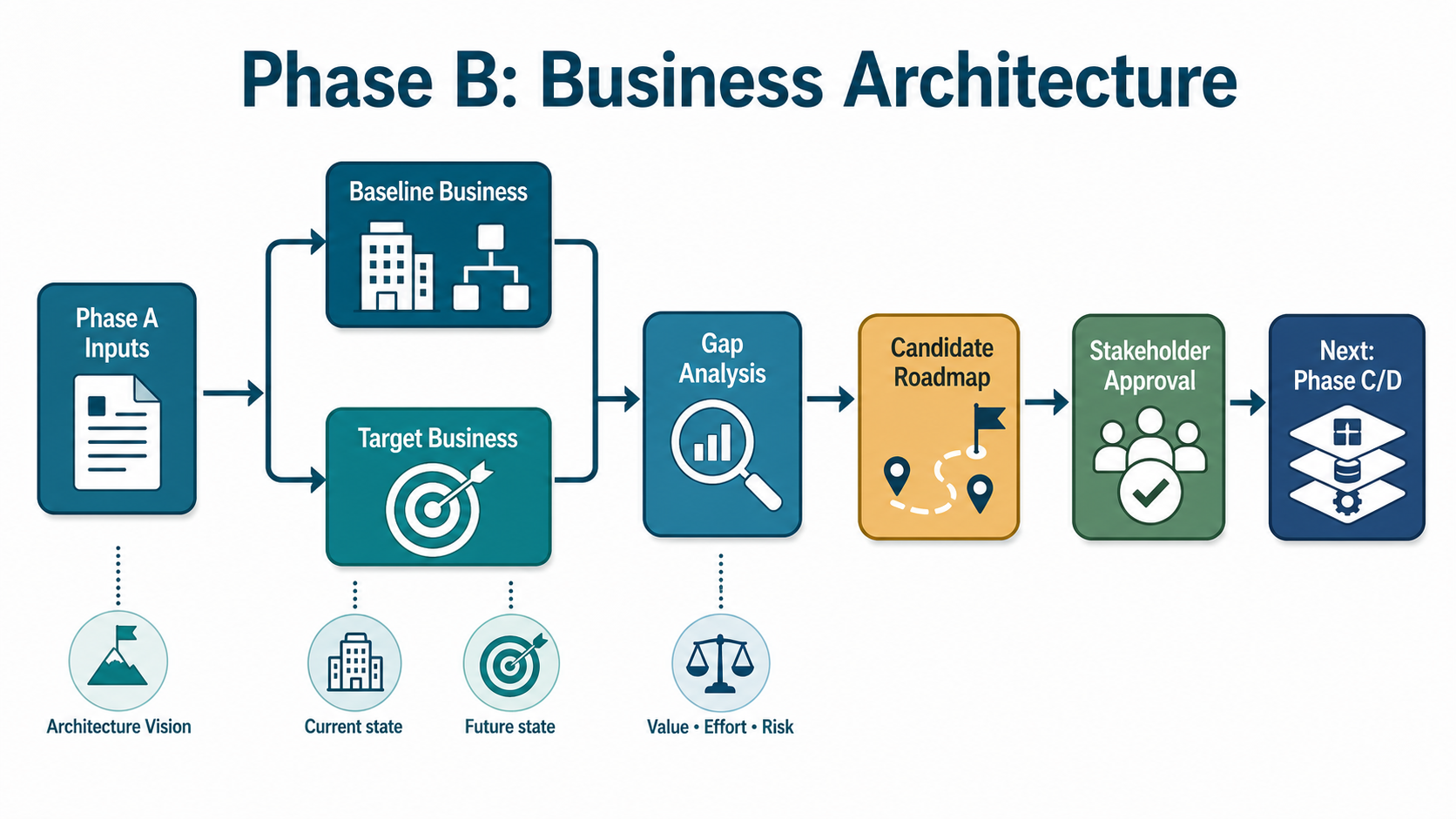
Where Phase B sits
Phase B is the second phase of the ADM cycle and the first domain-architecture phase:
- B — Business Architecture (this phase)
- C — Information Systems Architecture (Data + Application)
- D — Technology Architecture
Business architecture comes first because it sets direction. Data, application, and technology architectures align to business needs.
Purpose
Develop a Business Architecture to support an agreed Architecture Vision.
Inputs from Phase A
Phase B usually starts from these agreed Phase A outputs:
Exam shortcut
The purpose statement for Phases B, C, and D follows the same pattern:
- Phase B: develop a business architecture to support an agreed Architecture Vision
- Phase C: develop an information systems architecture to support an agreed Architecture Vision
- Phase D: develop a technology architecture to support an agreed Architecture Vision
Objectives
- Develop the target Business Architecture. Describe how the enterprise needs to operate to meet business goals, respond to strategic drivers, and address stakeholder concerns defined in Phase A.
- Identify candidate Architecture Roadmap components based on gaps between the baseline and target Business Architectures.
Core activities
Phase B focuses on three things:
| Activity | What it means |
|---|---|
| Gap analysis | Compare baseline and target Business Architectures, then validate against stakeholder concerns. The differences that matter are the gaps. |
| Candidate roadmap components | Identify the changes that may become part of the Architecture Roadmap. These describe the work needed to close the important gaps. |
| Stakeholder trade-offs | Rebalance priorities based on value, effort, and risk. Some changes may not be justified once these trade-offs are reviewed. |
flowchart LR
    BL["Baseline Business Architecture"] --> GAP["Gap Analysis"]
    TGT["Target Business Architecture"] --> GAP
    GAP --> WP["Candidate Roadmap Components"]
    WP --> EVAL["Value vs. Effort vs. Risk"]
    EVAL --> APPROVE["Stakeholder Approval"]
    APPROVE --> CD["Proceed to Phase C"]
Output and outcome
- A Business Architecture approved by stakeholders for the problem being addressed
- A set of gaps identified and understood by stakeholders
- Candidate Architecture Roadmap components to close the gaps, with value, effort, and risk understood
Stakeholder management in Phase B
Stakeholders need to understand the gaps, the required work, the added value, and the associated risks. Without this, conflicts around priorities are hard to resolve.
Always check whether the added value from a change justifies the effort and risk of implementing it.
Exam note
- Phase B is the first domain-architecture phase. Business architecture is the prerequisite for work in other domains.
- The purpose follows the same pattern as Phases C and D: develop an architecture to support the agreed Architecture Vision.
- Gap analysis produces gaps between baseline and target. Candidate Architecture Roadmap components describe the work needed to close those gaps.
- Stakeholder priorities may shift based on value, effort, and risk trade-offs.
- Output: approved Business Architecture with gaps and candidate roadmap components understood by stakeholders.