TL;DR
Phase H manages change to the new architecture after implementation. It monitors value realization, manages new or changed requirements, keeps the ADM cycle alive, executes architecture governance, and checks whether the enterprise architecture capability still meets current needs.
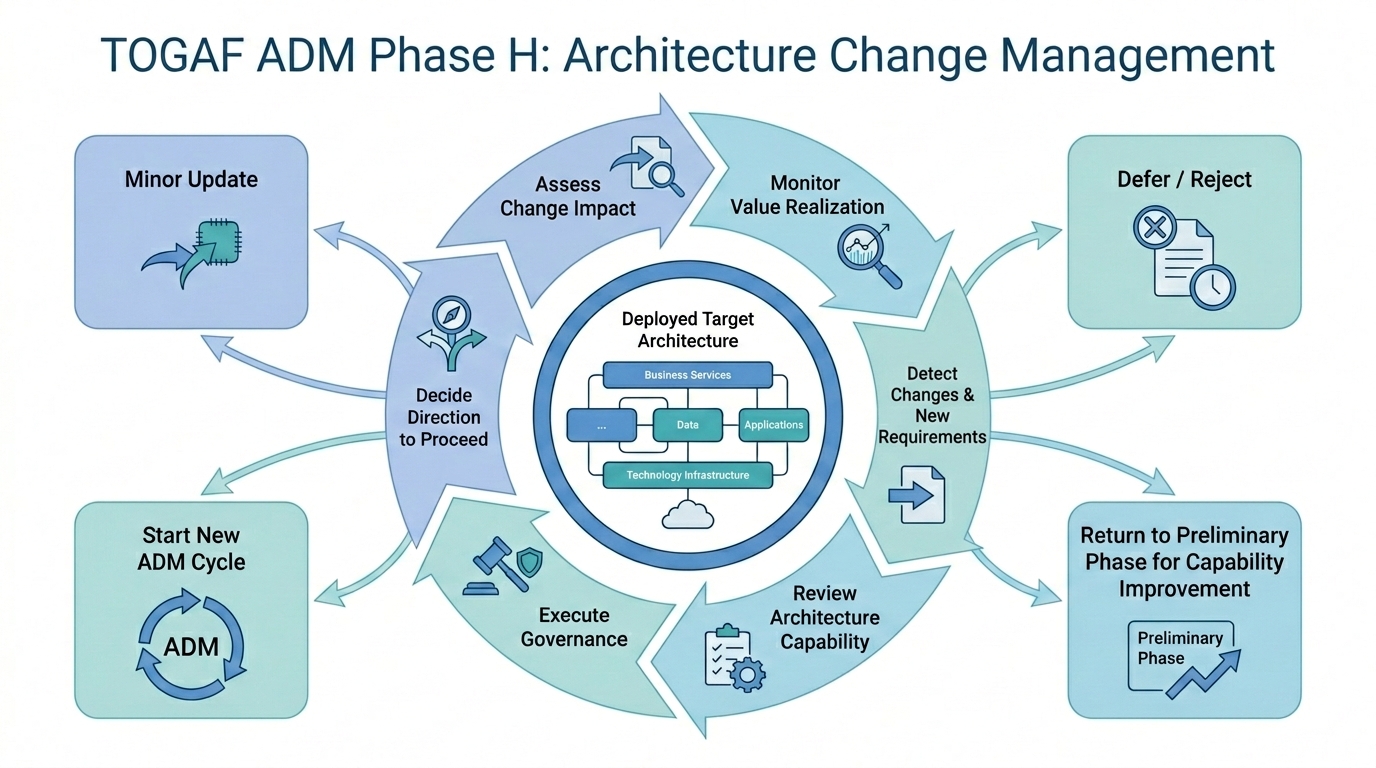
Purpose
The purpose of Phase H is to establish procedures for managing change to the new architecture.
It also supports value realization.
Value realization means checking whether the architecture achieves the original target business value stated in the Architecture Vision.
To do this, the Enterprise Architect identifies gaps between the target results and the actual results of the architecture.
Those gaps show whether there is any deviation from the promised business value.
Managing change
Stakeholder preferences can change.
Requirement priorities can change.
New requirements can arise, and existing requirements can change.
Phase H manages these changes and decides whether they are significant enough to trigger a new ADM cycle.
Main output and outcome
The output and outcome of Phase H is a direction to proceed.
That direction may be to start developing a target architecture that addresses perceived, real, or anticipated shortfalls in the enterprise relative to stakeholder preferences.
In simpler terms, Phase H decides what to do when the current architecture no longer fully satisfies what the enterprise needs.
Objective 1: Maintain the architecture development cycle
Phase H helps keep the ADM cycle alive.
After architecture development, planning, and implementation are complete, Phase H acts like a monitoring and holding phase.
The Enterprise Architect monitors the architecture and the architecture capability, waiting for changes, deficiencies, or new requirements to become visible.
When changes become known, the Enterprise Architect decides whether they are enough to start a new ADM cycle.
Objective 2: Execute architecture governance
Phase H ensures that the architecture governance framework is executed.
This includes arranging Architecture Board meetings and using governance mechanisms to decide how to deal with changes.
The governance response may include:
- accepting the change
- rejecting the change
- deferring the change
- treating the change as a minor update
- starting a new ADM cycle
Objective 3: Keep the architecture capability current
Phase H also checks whether the enterprise architecture capability meets current requirements.
This relates to gaps in the architecture capability itself.
If there is a deficit between the actual architecture capability and the target architecture capability, the Enterprise Architect takes countermeasures.
In that situation, the organization may return to the Preliminary Phase to enhance the architecture capability.
A useful caveat
Phase H is called Architecture Change Management, but it contains more than architecture change handling.
It also includes monitoring, value realization, governance execution, and architecture capability review.
These topics are important, but Phase H can feel like a container for several activities that happen after implementation.
For study purposes, keep the official intent clear: Phase H manages change and keeps the ADM cycle responsive after architecture implementation.
Exam note
- Phase H is Architecture Change Management.
- It is the last phase of the ADM cycle.
- It establishes procedures for managing change to the new architecture.
- It checks value realization against the business value promised in the Architecture Vision.
- It identifies gaps between target results and actual results.
- It manages changing stakeholder preferences, changing requirements, and new requirements.
- It decides whether changes are significant enough to trigger a new ADM cycle.
- It ensures the architecture development cycle is maintained.
- It ensures the architecture governance framework is executed.
- It ensures the enterprise architecture capability continues to meet current requirements.
- If the architecture capability has a gap, the organization may return to the Preliminary Phase.