TL;DR
The Architecture Roadmap describes the timeline for moving from baseline architecture to target architecture. In Phase E, it consolidates work packages and transition architectures into a delivery-oriented view of the transformation.
What it is
The Architecture Roadmap is a key deliverable of Phase E: Opportunities and Solutions.
Roadmap
An abstracted plan for business or technology change, typically operating across multiple disciplines over multiple years. Common examples include Technology Roadmap and Architecture Roadmap.
It shows the what of the transformation:
- what must change between baseline and target architecture
- which work packages realize the target architecture
- how transition architectures move the enterprise forward over time
- what business value each work package is expected to produce
The roadmap starts from the baseline architecture and describes the progression toward the target architecture.
Why it matters
Phase E is where the architecture starts becoming delivery-shaped.
The Architecture Roadmap helps stakeholders understand:
- which changes are required
- which work packages deliver those changes
- how work packages depend on each other
- which transition architectures are needed
- what value is expected from the work
- how the transformation progresses over time
Always attach business value to work packages. Stakeholders need to see the benefit behind the activity.
Main elements
The main elements of the Architecture Roadmap are work packages.
| Element | What it captures |
|---|---|
| Work package | Description of work needed to realize part of the target architecture |
| Dependencies | Relationships between work packages, gaps, solutions, or delivery constraints |
| Business value | Benefit expected for stakeholders |
| Architecture links | Links to the Architecture Definition Document and Requirements Specification |
| Transition architectures | Intermediate architecture states that deliver value on the way to the target |
| Implementation details | High-level implementation considerations and recommendations |
Each transition architecture and work package should have a clear set of outcomes.
The level of detail in the Architecture Roadmap should be similar to the level of detail in the Architecture Definition Document.
Roadmap components
The main input for the Architecture Roadmap is the set of roadmap components.
Roadmap components come from the architecture domains developed in Phases B, C, and D.
| Domain | Typical roadmap components |
|---|---|
| Business Architecture | processes, capabilities, value streams |
| Information Systems Architectures | applications, information concepts, interfaces |
| Technology Architecture | server infrastructure, platforms, network elements |
These components are shaped into work packages and transition architectures during Phase E.
Relationship to work packages
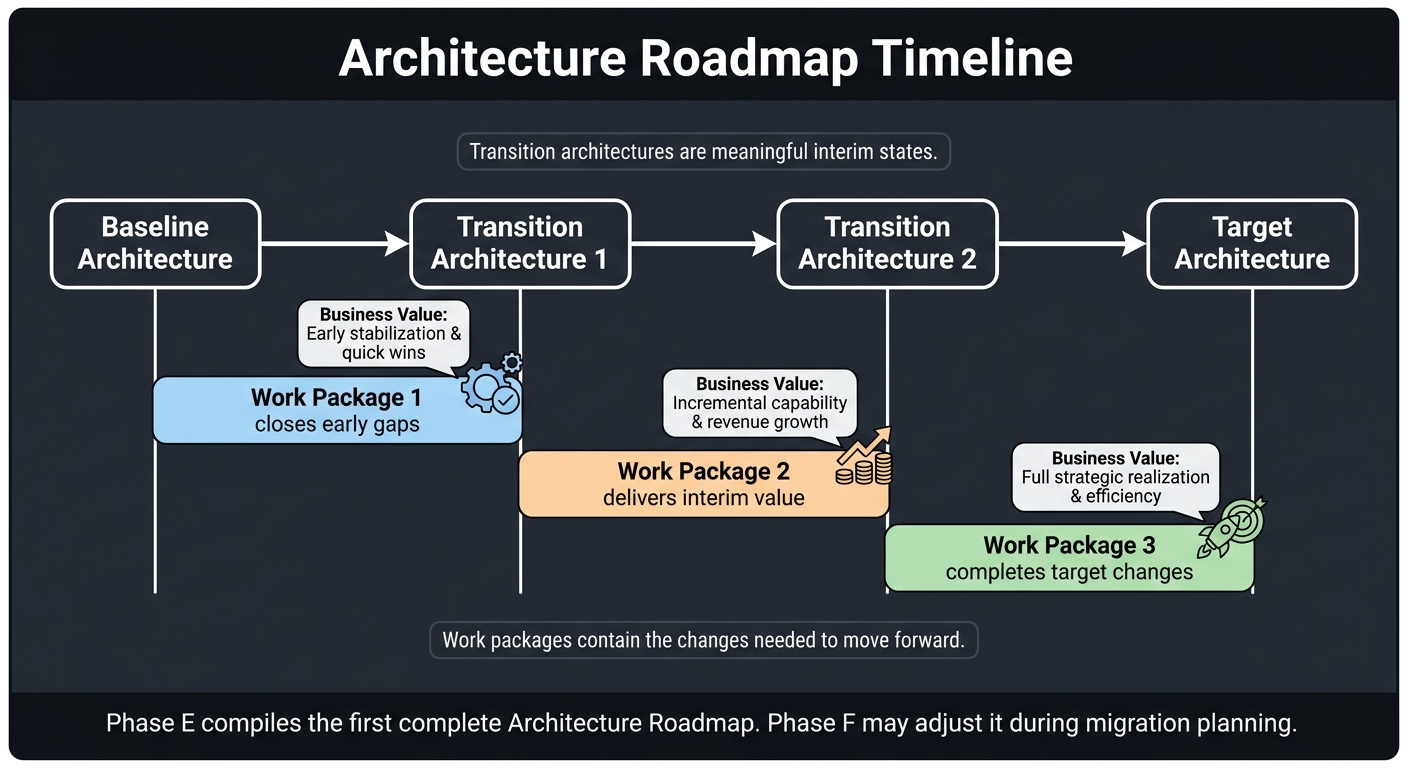
Work packages are the building blocks of the roadmap. Architecture gaps and roadmap components are shaped into work packages, while transition architectures provide meaningful intermediate states.
Common content
An Architecture Roadmap document may include:
- list of work packages
- list of projects or delivery initiatives
- transition architectures
- migration plan outline
- implementation recommendations
- dependencies
- business value
- links to architecture definition and requirements content
The TOGAF library provides a Microsoft Word template, but the exact format can vary by organization.
The roadmap is paired with the Implementation and Migration Plan, which turns roadmap direction into executable project planning.
ADM usage
| ADM point | How the roadmap is used |
|---|---|
| Phase E: Opportunities and Solutions | First complete version is compiled by consolidating work packages and transition architectures |
| Phase F: Migration Planning | Roadmap is adjusted and used to complete the Implementation and Migration Plan |
| Phase G: Implementation Governance | Roadmap is used as governance input during implementation projects |
Phase E creates the roadmap direction. Phase F turns it into more detailed migration planning.
Related practitioner artifacts
Two practitioner-level artifacts often support roadmap development:
- Implementation Factor Catalog
- Consolidated Gaps, Solutions, and Dependencies Matrix
These help connect implementation factors, gaps, solution options, and dependencies. They are useful supporting artifacts, but the roadmap itself should stay understandable to stakeholders.
Exam note
- The Architecture Roadmap is created in Phase E.
- It consolidates work packages and transition architectures.
- It describes the timeline from baseline architecture to target architecture.
- Work packages should include description, dependencies, value, and links to architecture definition and requirements content.
- Roadmap components come from Business, Information Systems, and Technology Architectures.
- Phase F can adjust the roadmap and completes the Implementation and Migration Plan.
- Phase G uses the Architecture Roadmap as a governance input.