TL;DR
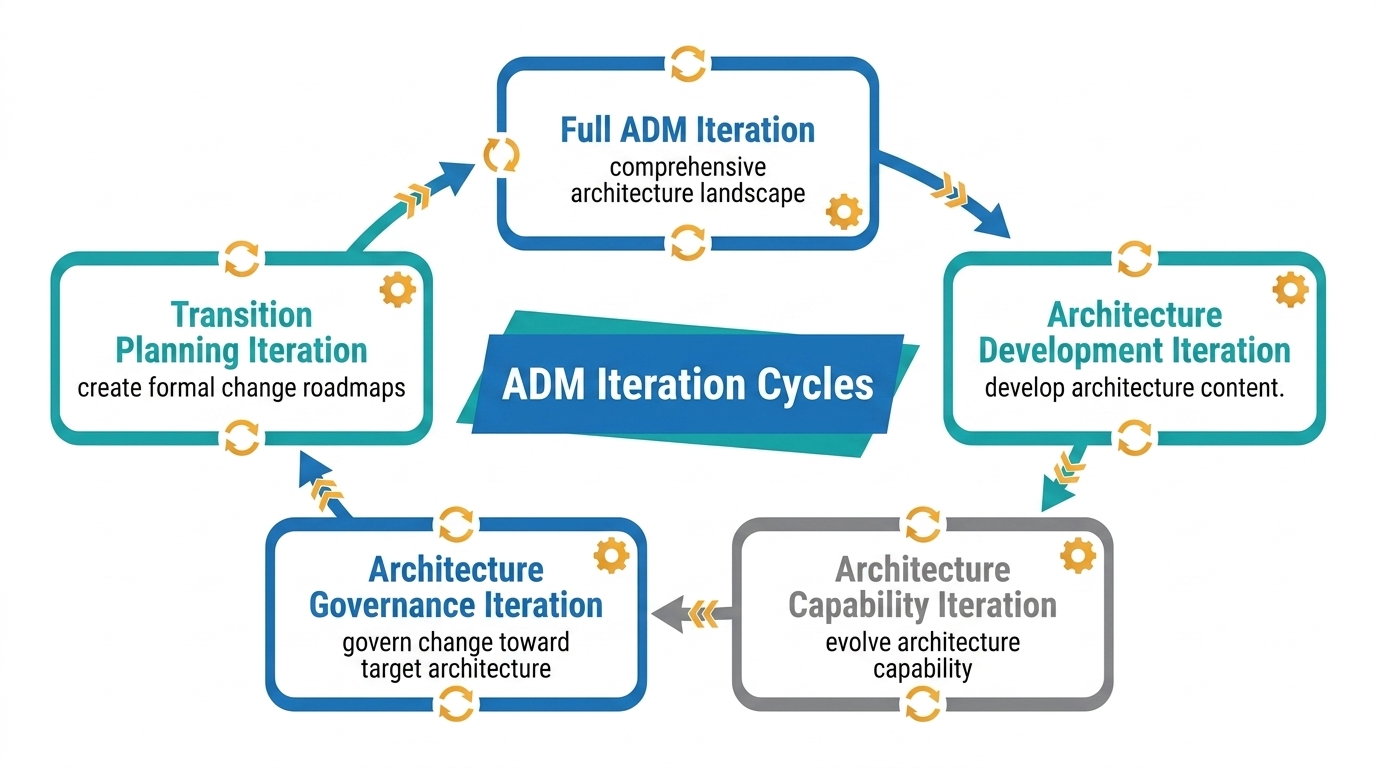
Iteration cycles group architecture activities for a specific purpose. Common cycles include full ADM iteration, architecture development iteration, architecture capability iteration, architecture governance iteration, and transition planning iteration.
What iteration cycles do
Iteration cycles group architectural activities to achieve a specific purpose.
They help the architecture team decide which parts of ADM to use and why.
Common iteration cycles
There are five common iteration cycles.
| Iteration cycle | Purpose |
|---|---|
| Full ADM iteration | develops a comprehensive architecture landscape |
| Architecture development iteration | creates architecture content and considers the architecture as a whole |
| Architecture capability iteration | creates or evolves the architecture capability |
| Architecture governance iteration | governs change activities that progress toward a target architecture |
| Transition planning iteration | supports creation of formal change roadmaps for defined architectures |
Full ADM iteration
A full ADM iteration runs through the entire ADM cycle.
It develops or extends a comprehensive enterprise architecture landscape.
Each cycle starts with Phase A: Architecture Vision and is bound to a Request for Architecture Work.
The architecture outputs populate the architecture landscape by:
- extending the landscape description
- changing the landscape where required
- adding new architecture content
- refining existing content
Parallel full ADM iterations
Separate architecture projects may operate their own ADM cycles concurrently.
This is called parallel iteration.
For example, two teams may work on different architecture partitions at the same time.
Each team runs its own ADM cycle, and each cycle is tied to its own Request for Architecture Work.
This connects to Architecture Partitioning.
Sequential full ADM iterations
ADM iterations can also happen sequentially.
One architecture project may trigger another architecture project.
This is useful when:
- a higher-level architecture identifies opportunities that need more detailed architecture
- a project identifies landscape impacts outside the scope of its Request for Architecture Work
- a solution decision requires a new architecture project
Architecture development iteration
Architecture development iteration happens within an ADM cycle.
It may cover phases B to F.
Within one ADM cycle, projects may:
- operate multiple ADM phases concurrently
- cycle between ADM phases in planned multi-phase cycles
- return to previous phases
Operating multiple phases concurrently
Operating multiple phases concurrently is useful for managing interrelationships between:
- Business Architecture
- Data Architecture
- Application Architecture
- Technology Architecture
In practice, teams often work on business, data, application, and technology architecture at the same time so they can align the domains with each other.
This is why phases B, C, and D may be active together.
Cycling between phases
Cycling between ADM phases in planned cycles is useful when the team needs to converge on a detailed target architecture.
This is especially important when a higher-level architecture does not exist to provide context and constraints.
The team may need several passes across multiple phases before the target architecture is coherent enough to move forward.
Returning to previous phases
Returning to previous phases is used to update work products with new information.
It is also used to converge on an executable Architecture Roadmap or Implementation and Migration Plan.
This may happen when implementation details or the scope of change trigger changes or reprioritization of stakeholder requirements.
Architecture capability iteration
Architecture capability iteration is an iteration back to the Preliminary Phase.
It supports the creation and evolution of the architecture capability.
If the current architecture capability is not sufficient to do the architecture work, the organization may need to iterate back to Preliminary.
This can happen when:
- Phase A identifies missing architecture capability needed to address a Request for Architecture Work
- Phase H identifies new change requirements for the architecture capability
- the organization needs to strengthen governance, methods, skills, tools, or roles
Put simply: if the architecture capability is not sufficient, iterate back to Preliminary and improve it.
Exam note
- Iteration cycles group architecture activities for a specific purpose.
- Five common cycles are full ADM iteration, architecture development iteration, architecture capability iteration, architecture governance iteration, and transition planning iteration.
- Full ADM iteration develops a comprehensive architecture landscape.
- Full ADM iterations can run in parallel or sequentially.
- Parallel iterations are useful for different architecture partitions.
- Architecture development iteration happens within an ADM cycle and may cover phases B to F.
- Phases B, C, and D are often worked concurrently to align business, data, application, and technology architecture.
- Returning to previous phases helps update work products with new information.
- Architecture capability iteration goes back to Preliminary when the architecture capability must be created, re-established, or improved.