TL;DR
Phase G deploys the target architecture through incremental transitions. Each transition should deliver business value, reduce transformation risk, follow existing portfolio or program management mechanisms, and connect architecture to implementation through the Architecture Contract.
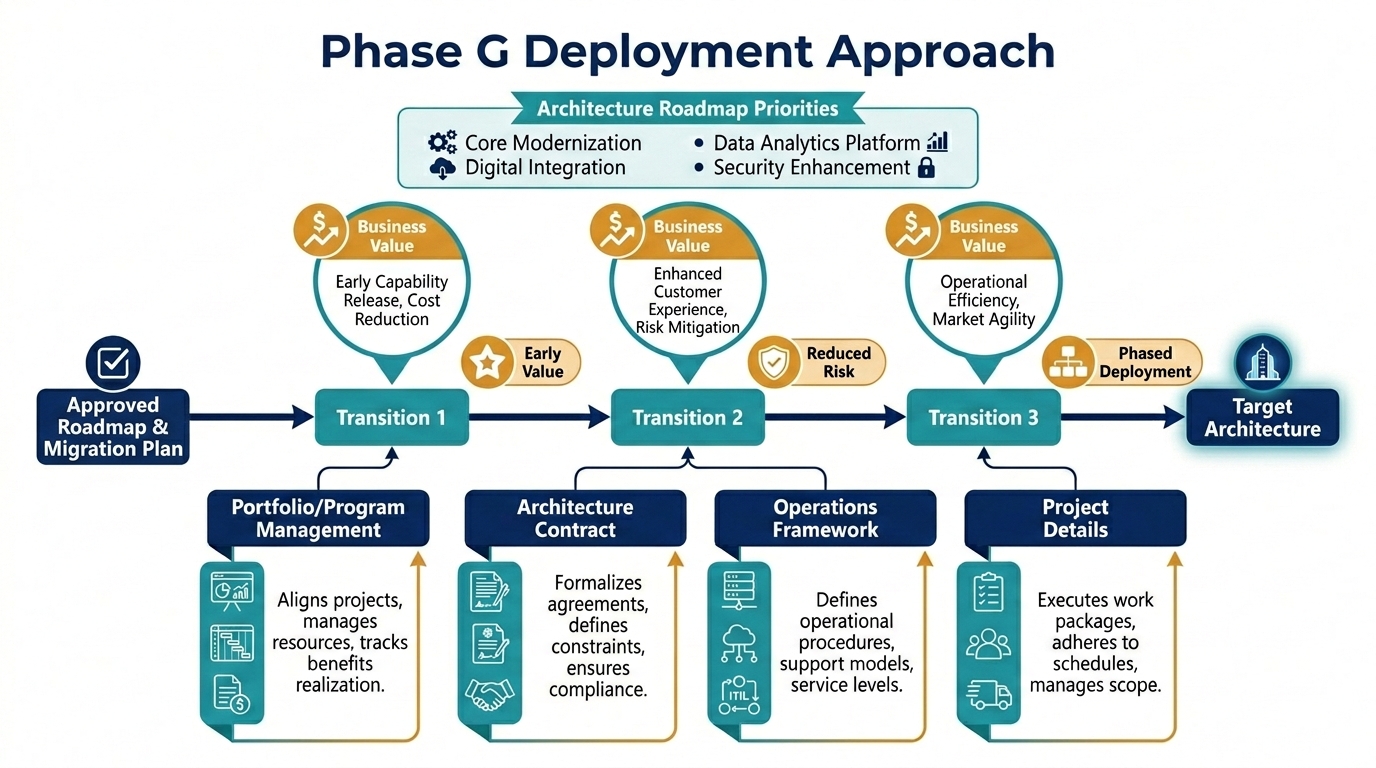
General approach
The TOGAF Standard suggests deploying the target architecture as a series of transitions.
This means implementation moves in incremental steps toward the target architecture, rather than trying to deliver the whole target state at once.
Each step should deliver business value while moving the enterprise closer to the approved target architecture.
Why use transitions
An incremental approach helps the enterprise:
- realize business value and benefits earlier
- reduce transformation and migration risk
- make progress visible to stakeholders
- adjust delivery based on learning
- avoid waiting until the end of a large program to see value
These increments are often expressed through Transition Architectures and the Architecture Roadmap.
Implementation program
Phase G should establish an implementation program that enables delivery of the Transition Architectures.
The deployment schedule should be phased and should reflect the business priorities already embodied in the Architecture Roadmap.
In practice, this means the roadmap is not only a planning document. It becomes a governance input for deciding what should be delivered, in what sequence, and under what constraints.
Use existing management mechanisms
Phase G should follow the organization’s established portfolio or program management approach.
The Enterprise Architect should not reinvent management mechanisms where the organization already has working ones.
Instead, architecture governance should integrate with existing ways of managing:
- portfolios
- programs
- projects
- delivery milestones
- risks
- change control
This keeps architecture governance connected to how work is actually funded, managed, and delivered.
Operations framework
Phase G should also define an operations framework for the deployed solution.
This matters because implementation is not finished simply because a solution is built.
Someone must be responsible for running, supporting, maintaining, improving, and evolving the solution after deployment.
The operations framework helps ensure the deployed solution has an effective long life beyond implementation.
Implementation project details
Phase G develops practical details for each implementation project.
Examples include:
- project name
- project description
- scope
- acceptance criteria
- measures of effectiveness
- delivery responsibilities
- governance checkpoints
These details make it easier to judge whether the implementation project is delivering the intended architectural and business outcomes.
Architecture and implementation connection
Phase G establishes the connection between the architecture organization and the implementation organization through the Architecture Contract.
The Architecture Contract makes expectations explicit and helps ensure implementation conforms to the target architecture.
Exam note
- Phase G deploys the target architecture as a series of transitions.
- Each transition should deliver business value while moving toward the target architecture.
- Incremental delivery supports early value realization and risk reduction.
- Phase G establishes an implementation program to deliver Transition Architectures.
- The phased deployment schedule should reflect business priorities in the Architecture Roadmap.
- Use the organization’s established portfolio or program management approach.
- Define an operations framework so the solution can be run and evolved after implementation.
- Develop implementation project details such as project name, description, acceptance criteria, and measures of effectiveness.
- Phase G connects architecture and implementation through the Architecture Contract.