TL;DR
The Implementation and Migration Plan describes how the Architecture Roadmap will be realized. In Phase E, an initial version is created and aligned to the roadmap; in Phase F, it is refined, finalized, and approved.
What it is
The Implementation and Migration Plan is a major ADM deliverable connected to Architecture Roadmap delivery.
Once the Architecture Roadmap is created in Phase E, the initial Implementation and Migration Plan can be created and aligned to it.
The plan contains a schedule of executable projects that move the enterprise toward the target architecture.
Those projects may be grouped into managed programs and portfolios.
Roadmap vs plan
The Architecture Roadmap and Implementation and Migration Plan work together, but they answer different questions.
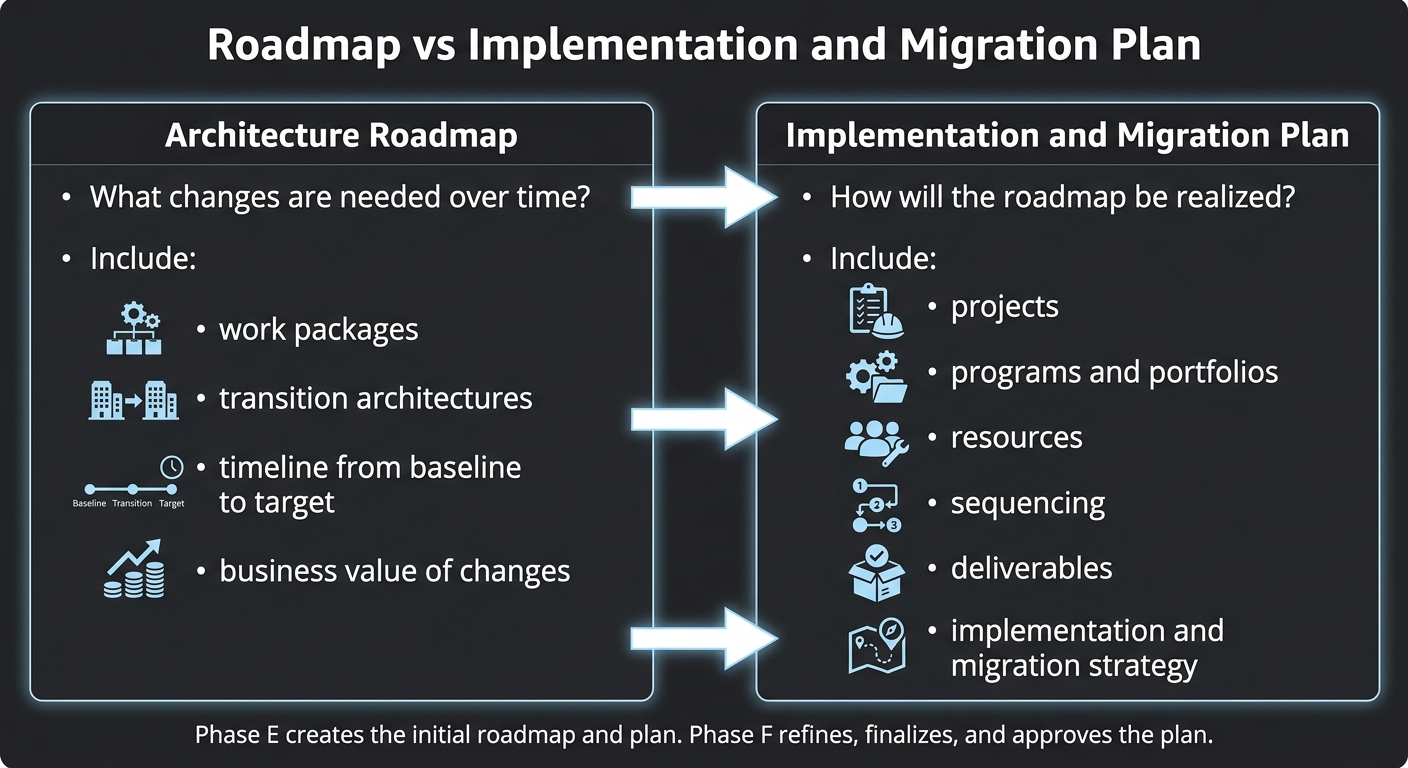
The Architecture Roadmap shows the what of the transformation.
The Implementation and Migration Plan shows the how.
Typical content
Typical content includes:
- project charters
- project breakdown structure
- expected work packages
- expected deliverables
- implementation and migration strategy
- direction and sequencing approach
- managed portfolios and programs
- project schedule
- resource requirements
- migration strategy
- implementation recommendations
The level of detail in the plan should align with the level of detail in the Architecture Roadmap.
Relationship to work packages
Work packages are translated into projects, programs, and portfolios.
flowchart LR
    ROAD["Architecture Roadmap"]
    WP["Work Packages"]
    PROJ["Projects"]
    PROG["Programs"]
    PORT["Portfolios"]
    PLAN["Implementation and Migration Plan"]
    F["Phase F<br/>Migration Planning"]

    ROAD --> WP
    WP --> PROJ
    PROJ --> PROG
    PROG --> PORT
    PORT --> PLAN
    PLAN --> F
The plan identifies the projects and resource requirements needed to realize the roadmap.
ADM usage
| ADM point | How the plan is used |
|---|---|
| Phase E: Opportunities and Solutions | Initial version is created after the Architecture Roadmap and aligned to roadmap detail |
| Phase F: Migration Planning | Plan is refined, finalized, and approved |
| Phase G: Implementation Governance | Plan guides implementation governance and delivery monitoring |
| Phase H: Architecture Change Management | Plan can act as input when architecture change affects implementation direction |
Phase E starts the plan. Phase F completes it.
Why it matters
The target architecture remains theoretical unless it can be translated into executable delivery work.
The Implementation and Migration Plan makes the transformation actionable by identifying:
- which projects are needed
- how projects are grouped
- which work packages and deliverables are expected
- what resources are required
- how implementation should be sequenced
- how migration toward the target architecture will proceed
Exam note
- The Implementation and Migration Plan is initiated in Phase E.
- It is aligned to the Architecture Roadmap.
- It contains a schedule of projects toward the target architecture.
- It includes executable projects grouped into managed portfolios and programs.
- Typical content includes project charters, project breakdown structure, work packages, deliverables, implementation strategy, and migration strategy.
- The Architecture Roadmap shows the what; the Implementation and Migration Plan shows the how.
- Phase F refines, finalizes, and approves the plan.