TL;DR
Phase E turns architecture definition into delivery thinking. It uses four main concepts: the Architecture Roadmap, work packages, transition architectures, and the Implementation and Migration Plan.
Four delivery concepts
TOGAF uses four concepts to move from developing a target architecture to delivering it.
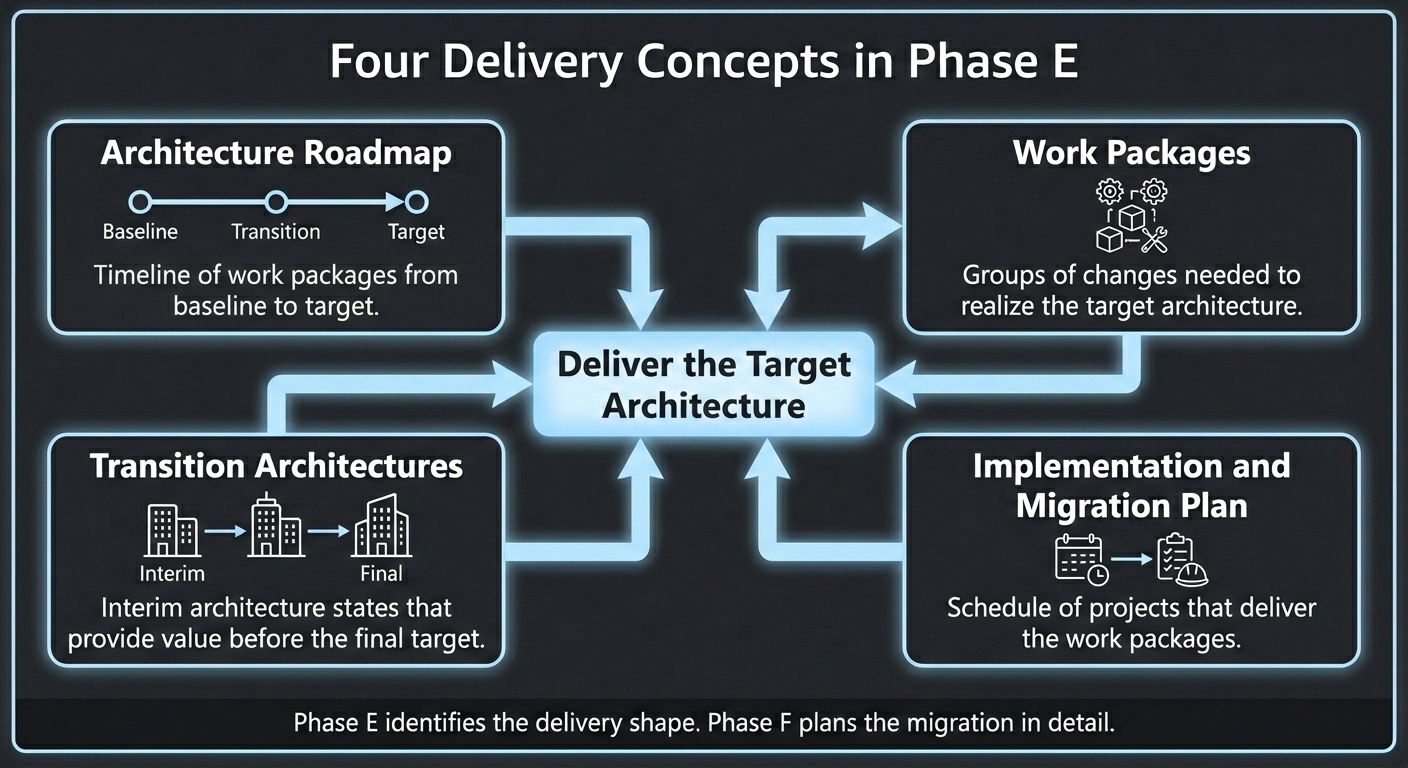
How the concepts fit
The Architecture Roadmap shows the work packages on a timeline. It describes the progression from the baseline architecture toward the target architecture.
Work packages group the changes needed to realize the target architecture. They are the practical chunks of work that later become part of projects, programs, or portfolios.
Transition architectures define meaningful interim states between the baseline and target architecture. They are useful when the target cannot be reached in one step, or when the organization needs measurable value along the way.
The Implementation and Migration Plan schedules the projects that will deliver the work packages and realize the target architecture.
Phase E to Phase F
Phase E initializes the Implementation and Migration Plan.
Phase F, Migration Planning, picks up that plan, adds detail, and finalizes it.
The simple memory hook is:
- Phase E identifies the delivery shape.
- Phase F plans the migration in detail.
Exam note
- Phase E is where the architecture starts turning into delivery options.
- The Architecture Roadmap lists work packages over time.
- Work packages group the changes needed to realize the target architecture.
- Transition architectures are interim architecture states between baseline and target.
- The Implementation and Migration Plan is only initialized in Phase E.
- Phase F details and finalizes the Implementation and Migration Plan.