TL;DR
Phase F turns the initial Implementation and Migration Plan from Phase E into a finalized plan. It confirms management coordination, assigns business value, estimates resources and timing, prioritizes migration projects, updates architecture deliverables, and completes the architecture development cycle.
Step-by-step flow
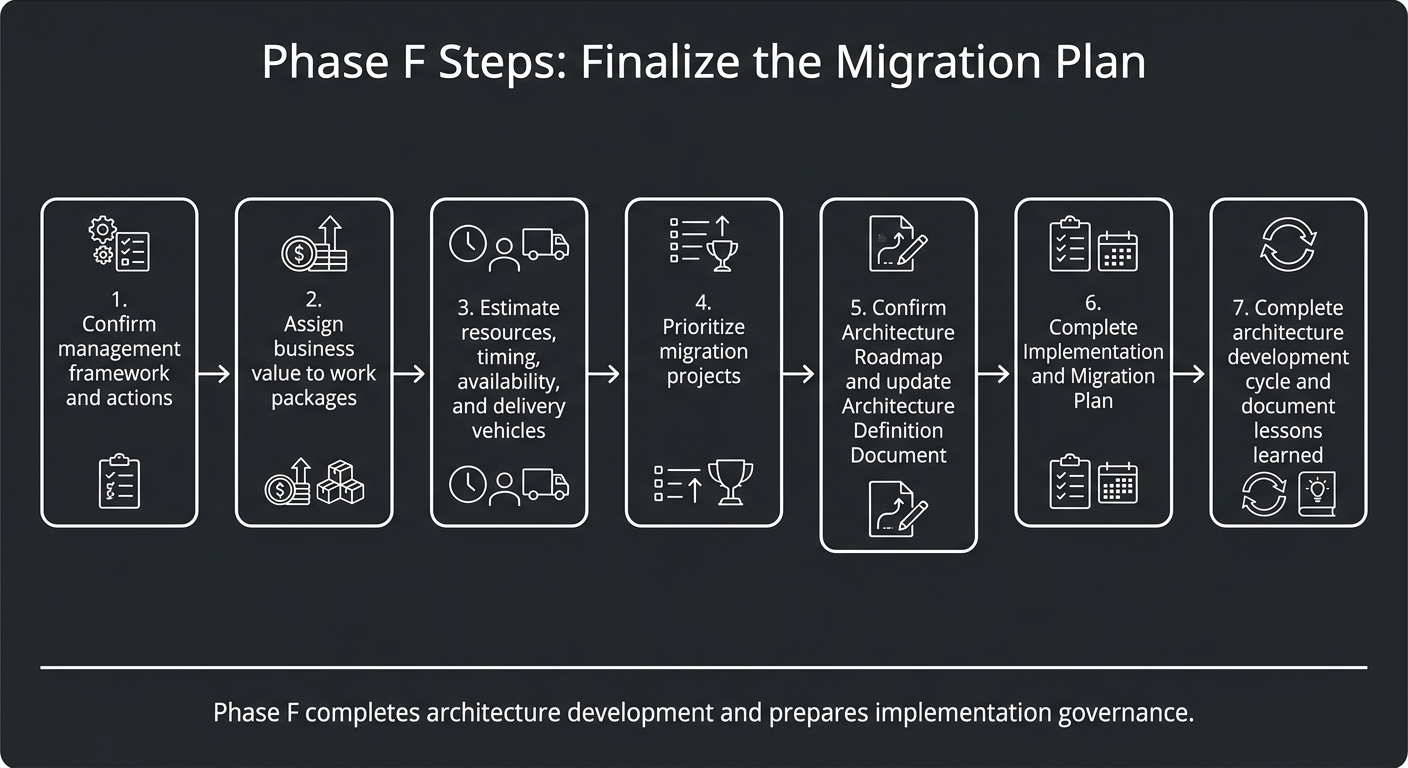
1) Confirm management framework and actions
Confirm that the Implementation and Migration Plan is coordinated with the management frameworks used by the enterprise.
Examples include:
- business planning framework
- project management framework
- portfolio management framework
- operations management framework
The point is to make sure the migration plan can work within the enterprise’s normal approach to managing change.
2) Assign business value to each work package
Assign business value to every work package.
This supports:
- trade-off decisions
- budget allocation
- comparison of cost, risk, and benefit
- stakeholder prioritization
Business value makes the migration plan easier to defend and easier to sequence.
3) Estimate resources, timing, availability, and delivery vehicles
Estimate what is required to deliver the work.
Consider:
- resource requirements
- project timing
- resource availability
- delivery vehicles
Delivery vehicles may include projects, programs, or portfolios, depending on how the enterprise organizes implementation work.
4) Prioritize migration projects
Prioritize migration projects using the information gathered in the previous steps.
This means comparing:
- business value
- cost
- required resources
- delivery timing
- risk
The prioritization is based on cost-benefit assessment and risk validation.
5) Confirm the Architecture Roadmap and update the Architecture Definition Document
Reconfirm the Architecture Roadmap after migration priorities are clearer.
Also update the Architecture Definition Document if the prioritization changes the delivery path or architecture content.
This matters because the cost-benefit assessment and risk validation may change the sequence or shape of migration projects.
6) Complete the Implementation and Migration Plan
Complete the Implementation and Migration Plan using accepted planning and management techniques.
Bring together:
- projects
- project plans
- activities
- internal dependencies
- external dependencies
- impact of change
This is where the planning work becomes a finalized implementation and migration plan.
7) Complete the architecture development cycle and document lessons learned
Complete the architecture development cycle and capture lessons learned.
This wording can feel odd because the ADM still has Phase G and Phase H.
The reason is that architecture development is now complete. The implementation projects can begin implementing the architecture, while Phase G provides implementation governance in parallel.
Phase H acts as architecture change management. It keeps the architecture capability ready for change after the architecture work, planning, and implementation activity have moved forward.
Exam note
- Phase F has seven steps.
- It coordinates the Implementation and Migration Plan with enterprise management frameworks.
- Business value is assigned to work packages.
- Resources, timing, availability, and delivery vehicles are estimated.
- Migration projects are prioritized using cost-benefit assessment and risk validation.
- The Architecture Roadmap is confirmed and the Architecture Definition Document may be updated.
- The Implementation and Migration Plan is completed in Phase F.
- The architecture development cycle is completed because development is done; Phase G governs implementation and Phase H manages change.