TL;DR
Phase E consolidates the gaps, requirements, constraints, dependencies, and risks from earlier ADM work. It then shapes the implementation and migration strategy, groups major work packages, identifies transition architectures, and creates the initial Architecture Roadmap and Implementation and Migration Plan.
Step order
TOGAF presents Phase E activities as steps, but the exact order and timing should be adapted to the situation and architecture governance.
For study purposes, the steps are easier to understand in sequence. Any activities started during these steps should be closed when creating the Architecture Roadmap and initial Implementation and Migration Plan.
Step-by-step flow
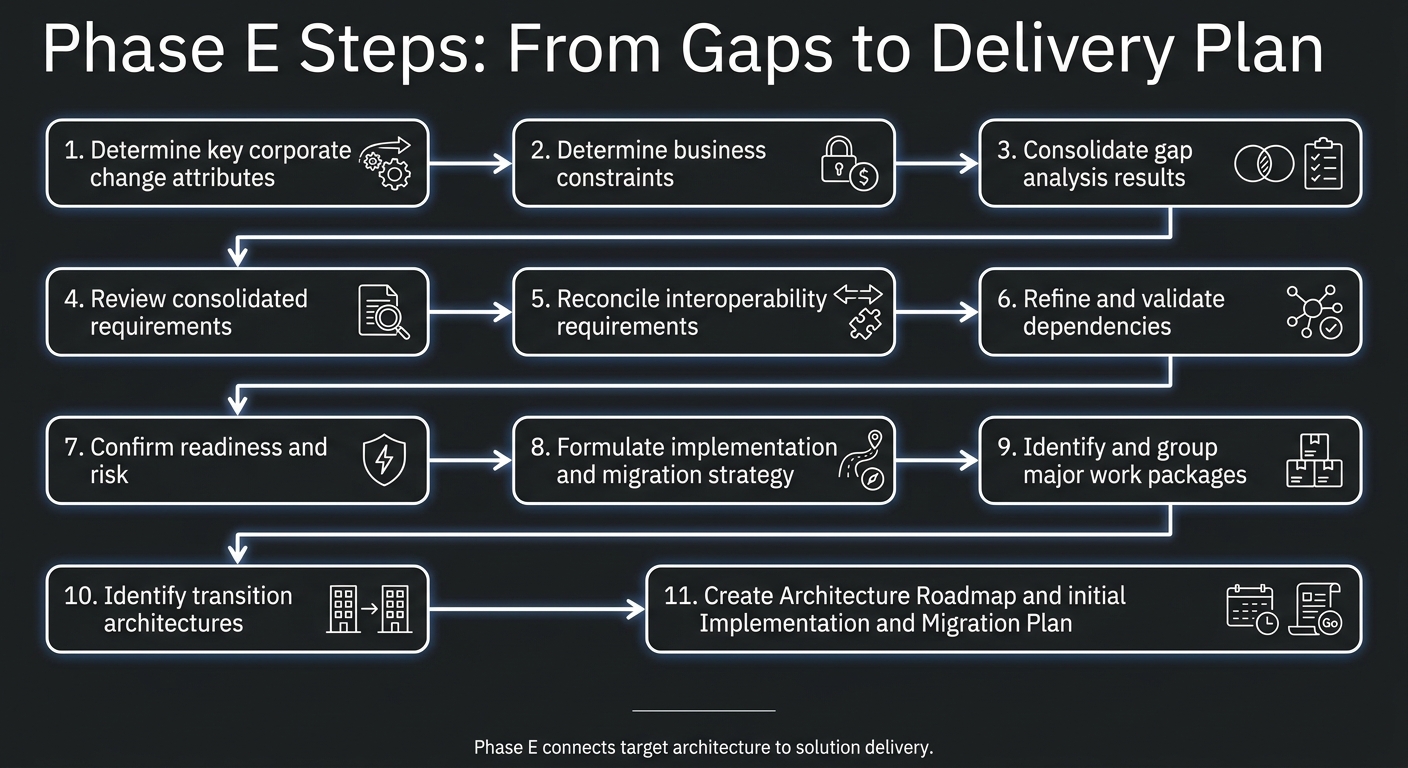
1) Determine key corporate change attributes
Determine how the architecture can be implemented in a way that fits the organization’s business culture.
Assess transition capability across involved organization units and the wider enterprise, including:
- culture
- abilities
- skills
- readiness to absorb change
These factors should influence the Implementation and Migration Plan.
2) Determine business constraints for implementation
Identify business drivers and constraints that affect implementation or the sequence of implementation.
Review:
- corporate business plans
- line-of-business plans
- strategic plans
- Enterprise Architecture Maturity Assessment findings
These constraints are important inputs for the Architecture Roadmap and Implementation and Migration Plan.
3) Review and consolidate gap analysis results
Review and consolidate gap analysis results from Phases B, C, and D.
This step creates the Consolidated Gaps, Solutions, and Dependencies Matrix.
The matrix helps group identified gaps and assess:
- potential solutions for each gap
- dependencies between gaps
- dependencies between possible solutions
- gaps that can be addressed by the same solution
The result is a list of one or more potential solutions for each gap between the baseline and target architectures.
4) Review consolidated requirements across related business functions
Assess requirements, gaps, solutions, and implementation factors to identify a minimal effective set of requirements.
Look for requirements that:
- have something in common
- can be fulfilled by the same solution
- create opportunities for reuse
- can be handled together across stakeholders or business functions
The goal is to improve implementation efficiency and exploit synergies.
5) Consolidate and reconcile interoperability requirements
Minimize interoperability conflicts before implementation planning becomes too detailed.
Interoperability issues often arise from:
- reused Solution Building Blocks
- commercial off-the-shelf products
- third-party service providers
- integration between old and new systems
This step checks whether proposed solutions can work together in practice.
6) Refine and validate dependencies
Identify dependencies and constraints that affect implementation sequencing.
Important dependencies may include:
- existing implementations of business services
- existing implementations of application services
- planned changes to business services
- planned changes to application services
- technology dependencies
- data migration dependencies
Once dependencies are clear, group related activities together. This creates a practical basis for implementation and migration projects.
7) Confirm readiness and risk for business transformation
Review the findings of the Business Transformation Readiness Assessment from Phase A.
Determine the impact on:
- Architecture Roadmap
- implementation strategy
- migration strategy
- transition architecture sequencing
Also identify, classify, and mitigate risks associated with the transformation effort.
8) Formulate the implementation and migration strategy
Create the overall strategy that will guide implementation of the target architecture.
The strategy should explain:
- how the enterprise will move from baseline to target
- whether implementation will be incremental
- how transition architectures will be structured
- how work packages will be grouped and sequenced
- how value, effort, risk, and constraints shape the delivery path
This is the core planning move in Phase E.
9) Identify and group major work packages
Create work packages that will realize the target architecture.
To do this:
- assess missing business capabilities from the Architecture Vision and target architecture
- group related activities logically
- consider dependencies between activities
- consider the strategic implementation approach
- group work packages into portfolios and projects where appropriate
Work packages connect architecture gaps to real implementation effort.
10) Identify transition architectures
Use transition architectures when the target architecture needs an incremental implementation path.
Transition architectures should:
- move the enterprise toward the target architecture
- provide measurable business value
- reduce delivery risk
- reflect realistic timing, funding, and strategic constraints
The time span between transition architectures does not have to be equal. It should reflect the transformation context.
11) Create the Architecture Roadmap and initial Implementation and Migration Plan
Consolidate work packages and transition architectures into the Architecture Roadmap.
The Architecture Roadmap describes the timeline and progression from baseline architecture to target architecture.
After the roadmap is created, initiate the Implementation and Migration Plan at a level of detail aligned with the Architecture Roadmap.
Important distinction:
- Phase E initiates the Implementation and Migration Plan
- Phase F completes the Implementation and Migration Plan
Phase E in one sentence
Phase E is the bridge between target architecture and solution delivery.
It concentrates on how to deliver the architecture.
Exam note
- Phase E consolidates gap analysis results from Phases B, C, and D.
- The Consolidated Gaps, Solutions, and Dependencies Matrix links gaps to potential solutions and dependencies.
- Phase E reviews requirements, interoperability, dependencies, readiness, and risk.
- Phase E formulates the implementation and migration strategy.
- Phase E identifies and groups major work packages.
- Transition architectures are used when an incremental path is needed.
- Phase E creates the Architecture Roadmap and initiates the Implementation and Migration Plan.
- Phase F completes the Implementation and Migration Plan.