TL;DR
Architecture Contracts are agreements between the architecture function, sponsors, business stakeholders, and delivery partners. They help ensure implementation work conforms to the target architecture by making deliverables, quality expectations, roles, responsibilities, measures, and governance rules explicit.
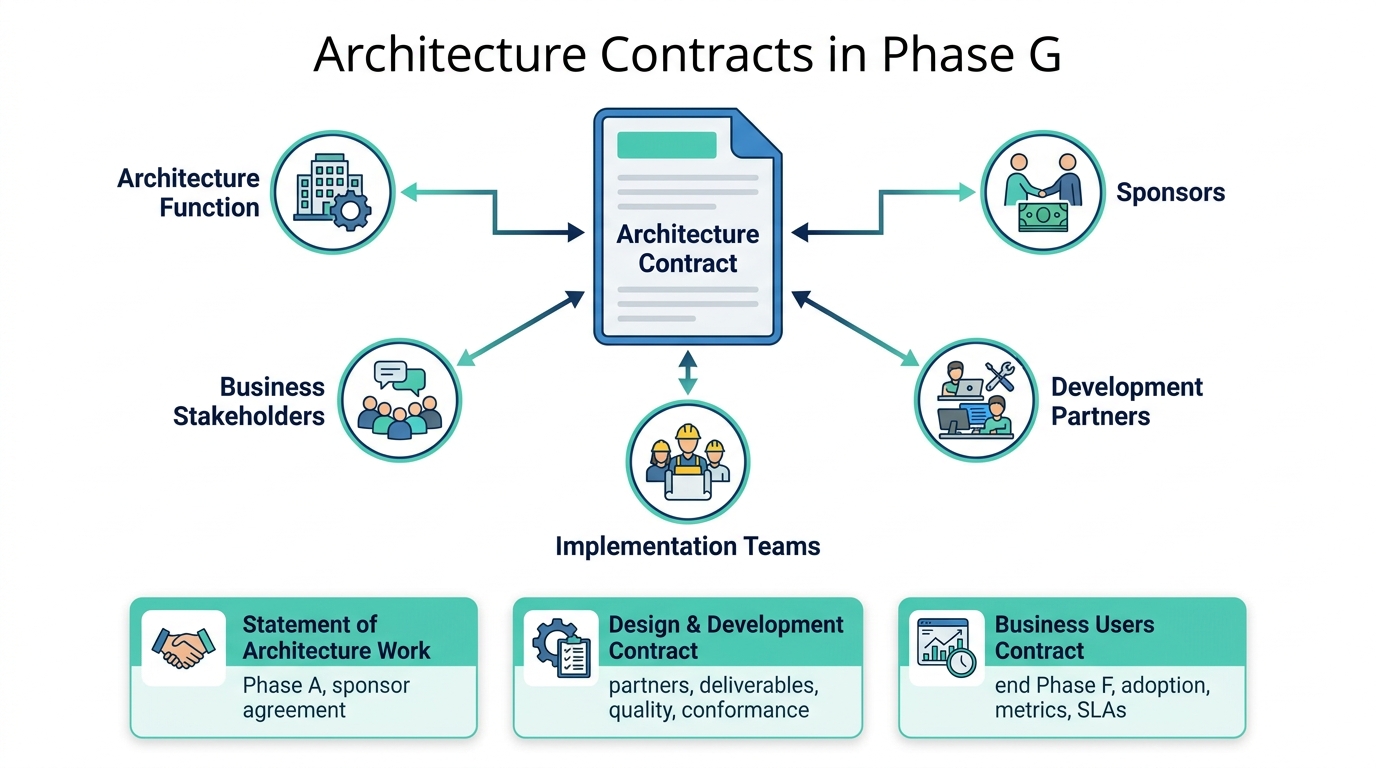
What architecture contracts are
An Architecture Contract is a joint agreement between the parties involved in architecture, development, and delivery.
It defines expectations for:
- deliverables
- quality
- fitness for purpose
- conformance requirements
- governance responsibilities
- delivery and business measures
The contract is realized through effective architecture governance.
In Phase G, Architecture Contracts are one of the simplest ways to connect architecture intent with implementation work.
Why they matter in Phase G
The purpose of Phase G is to provide architectural oversight of implementation and to guide implementation teams.
Architecture Contracts help do this by turning the target architecture into concrete agreements that delivery teams can work against.
They make it clear:
- what each team must deliver
- what quality level is expected
- which principles, standards, and requirements must be followed
- how conformance will be checked
- who has authority to approve or challenge changes
This supports a dynamic enterprise architecture because the architecture can evolve in response to changing technology and business drivers, while still remaining governed.
How the idea has evolved
In earlier usage, Architecture Contracts were often agreements between the sponsor and the architecture function or information systems department.
In modern delivery, they are broader agreements between all parties involved in architecture, development, and delivery.
These parties may include:
- sponsors
- business stakeholders
- architecture teams
- systems integrators
- application providers
- service providers
- implementation teams
Types of architecture contracts
There is not only one style of Architecture Contract.
Different contract types are used with different participants, purposes, and content.
| Contract type | Main participants | Main use |
|---|---|---|
| Statement of Architecture Work | architecting organization and sponsor | defines the scope and approach for an architecture development cycle |
| Architecture Design and Development Contract | architecture function and development partners | governs the design and development of the architecture or parts of it |
| Business Stakeholders Architecture Contract | architecture function and business stakeholders or users | governs adoption, implementation expectations, business measures, and service expectations |
Statement of Architecture Work
The Statement of Architecture Work is created in Phase A: Architecture Vision.
It is an Architecture Contract between the architecting organization and the sponsor of the enterprise architecture work.
It defines the scope and approach for the architecture development cycle and may form the basis for a contractual agreement between the supplier and consumer of architecture services.
Typical content includes:
- title and approvals
- change of scope procedures
- architecture project request
- background and description
- scope
- plan and schedule
- acceptance criteria and procedures
- roles and responsibilities
- deliverables
- overview of the Architecture Vision
Architecture Design and Development Contract
The Architecture Design and Development Contract is a statement of intent for designing and developing the enterprise architecture, or parts of it, with delivery partners.
Those partners may include systems integrators, application providers, and other service providers.
This type of contract defines:
- expected deliverables
- quality expectations
- fitness for purpose
- collaboration processes between partners
- conformance requirements
- architecture development and management responsibilities
It is defined at the appropriate ADM stage depending on the contracted work, and is used throughout Phase G to connect architecture with implementation.
Typical content includes:
- introduction and background
- nature of the agreement
- scope of the architecture
- architecture and strategic principles
- architecture requirements
- conformance requirements
- architecture development and management process
- roles and responsibilities
- target architecture measures
- defined phases of deliverables
- prioritized joint work plan
- time windows
- architecture, delivery, and business metrics
Business Stakeholders Architecture Contract
The Business Stakeholders Architecture Contract is also known as the Business Users Architecture Contract.
It is drawn up between the architecting function and the business stakeholders who will build, deploy, or adopt the architected business solutions.
It is created at the end of Phase F with the agreed Implementation and Migration Plan.
It is also used to manage changes to the enterprise architecture in Phase H.
Typical content includes:
- introduction and background
- nature of the agreement
- scope
- strategic requirements
- conformance requirements
- architecture deliverables
- architecture adopters
- time window
- architecture and business metrics
- service architecture
- service level agreements
Contract content comparison
Architecture Design and Development Contracts and Business Stakeholders Architecture Contracts are similar, but they emphasize different relationships.
| Area | Development partners contract | Business users contract |
|---|---|---|
| Main focus | delivery collaboration and architecture development | adoption, business usage, and service expectations |
| Participants | architecture function, systems integrators, application providers, service providers | architecture function, business stakeholders, business users |
| Detailed work plan | usually more detailed | usually less detailed |
| Communication plan | usually more detailed | usually less detailed |
| Business metrics | included | included |
| Service level agreements | may be included where relevant | usually more important |
Benefits
Architecture Contracts provide several governance benefits.
They help:
- ensure accountability, responsibility, and discipline through architectural artifacts
- continuously monitor architecture-related activities
- ensure adherence to architecture principles, standards, and requirements
- identify risks in architecture development and operation
- create a shared understanding of the governance organization
- clarify the level of authority and scope of the architecture
Exam note
- Architecture Contracts are used in Phase G to support implementation governance.
- They help ensure implementation conforms to the target architecture.
- They define deliverables, quality, fitness for purpose, roles, responsibilities, metrics, and conformance expectations.
- A contract is realized through effective architecture governance.
- The Statement of Architecture Work is an Architecture Contract created in Phase A.
- The Architecture Design and Development Contract is used with development partners and is important during Phase G.
- The Business Stakeholders or Business Users Architecture Contract is created at the end of Phase F and can support Phase H change management.
- There is no single universal Architecture Contract; different contract types have different participants, purposes, and contents.