TL;DR
Requirements Management alternates with the ADM phases. ADM phases identify and implement requirements, while Requirements Management consolidates them, maintains the requirements baseline, records priorities, manages conflicts, produces impact statements, and keeps the Architecture Requirements Repository updated.
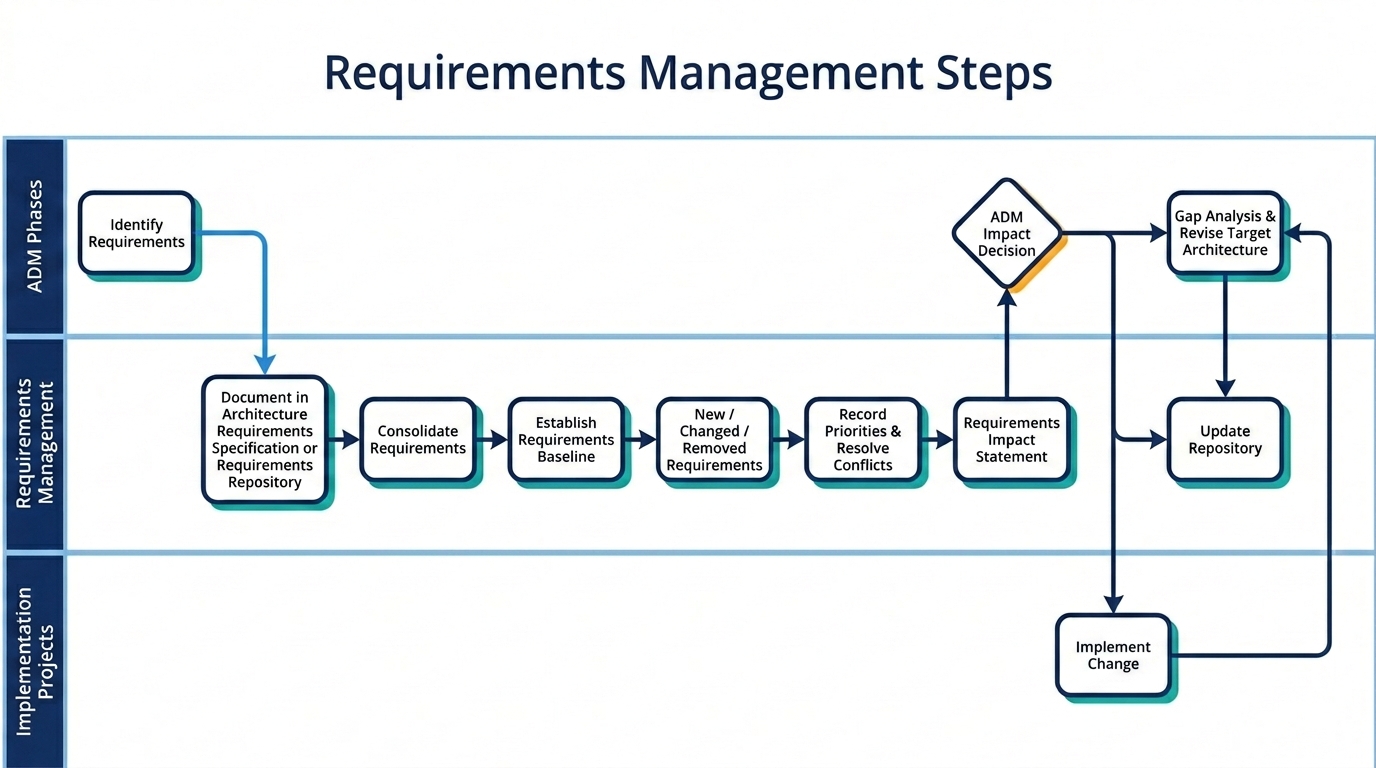
How the flow works
Requirements Management is embedded into the ADM by alternating between ADM phase work and requirements management work.
ADM phases identify, assess, and implement architecture requirements.
Requirements Management consolidates, stores, baselines, and distributes those requirements.
This back-and-forth keeps requirements controlled while architecture work continues.
1) Identify requirements in ADM phases
Requirements are identified during ADM phases.
Common inputs include:
- business goals
- business scenarios
- management information
- value streams
- user experience
- stakeholder concerns
The ADM phase work identifies the requirements because the architecture work reveals what is needed.
2) Document requirements in the right place
Requirements are documented in the Architecture Requirements Specification and/or the Architecture Requirements Repository.
| Requirement type | Where it goes |
|---|---|
| In scope for the current architecture project | Architecture Requirements Specification |
| Beyond the current architecture project scope | Architecture Requirements Repository |
The current project scope should align with the Request for Architecture Work and the Statement of Architecture Work.
3) Consolidate requirements and establish the baseline
In Requirements Management, consolidate the requirements and establish the requirements baseline.
A requirements baseline is a snapshot in time that contains agreed, reviewed, and approved requirements.
After the baseline is established, it should be monitored.
The baseline gives the architecture team a stable reference point for managing change.
4) Identify new, changed, or removed requirements
As ADM phase work continues, new or changed requirements may appear.
Existing requirements may also be modified or removed.
The ADM phases identify these changes and reassess requirement priorities.
When a new, changed, or removed requirement appears, the work returns to Requirements Management.
5) Record priorities, resolve conflicts, and produce an impact statement
Requirements Management records the new requirement priorities.
It also identifies and resolves conflicts caused by new or changed requirements.
Then it generates a requirements impact statement for the architecture team.
The requirements impact statement helps steer architecture decisions by showing what the requirement change affects.
6) Assess impact in ADM phases
The ADM phases assess the impact of the change on previous and current ADM phases.
They decide whether to:
- implement the change in the current ADM cycle
- defer the change to a later ADM cycle
- handle the change through implementation governance
- trigger further architecture work
If the requirement comes from Phase H: Architecture Change Management, the ADM phases decide how to implement the requirement.
Minor maintenance changes or requirements that do not require architecture rework may be implemented directly.
In that case, the architect can give the implementation team approval to proceed and ensure compliance through Phase G: Implementation Governance.
7) Update the Architecture Requirements Repository
Requirements Management updates the Architecture Requirements Repository with information related to the change request.
This includes affected stakeholder views.
The repository should capture the requirement, its priority, its rationale, its impact, and any affected architecture views or stakeholder concerns.
8) Implement changes through implementation projects
Changes are implemented by implementation projects.
Requirements Management does not itself implement the architecture work.
Its role is to keep the requirements controlled and available to the ADM phases and implementation governance.
9) Conduct gap analysis and record gap requirements
ADM phases conduct gap analysis for past phases.
They identify gap requirements and record them in the Architecture Requirements Repository.
TOGAF describes two common kinds of gaps.
| Gap type | Meaning |
|---|---|
| Present in baseline, absent in target | something exists today but is missing from the target, either by accident or by design |
| Absent in baseline, present in target | something does not exist today but is required in the target |
A gap requirement is a requirement created when something was eliminated by accident and therefore requires a change to the target architecture.
If gap analysis creates gap requirements, they must be addressed, documented, recorded in the Architecture Requirements Repository, and reflected in revisions to the target architecture.
This architecture work belongs to the ADM phases, not to Requirements Management itself.
Responsibilities
| Responsibility | Owner |
|---|---|
| Identify requirements through architecture work | ADM phases |
| Document in-scope requirements | ADM phases and Architecture Requirements Specification |
| Store beyond-scope requirements | Architecture Requirements Repository |
| Consolidate requirements and maintain the baseline | Requirements Management |
| Record priorities and conflicts | Requirements Management |
| Produce requirements impact statement | Requirements Management |
| Assess architecture impact and decide implementation/deferment | ADM phases |
| Implement changes | implementation projects |
| Conduct gap analysis and revise target architecture | ADM phases |
Exam note
- Requirements Management alternates with ADM phase execution.
- ADM phases identify requirements from business goals, scenarios, management information, value streams, user experience, and stakeholder concerns.
- In-scope requirements go into the Architecture Requirements Specification.
- Out-of-scope requirements go into the Architecture Requirements Repository.
- A requirements baseline is a snapshot of agreed, reviewed, and approved requirements.
- Requirements Management records new priorities, resolves conflicts, and creates requirements impact statements.
- ADM phases assess the impact on previous and current phases and decide whether to implement or defer changes.
- Minor changes that do not require architecture rework can be implemented directly with compliance governed through Phase G.
- Requirements Management updates the Architecture Requirements Repository with change-related information and affected stakeholder views.
- Gap requirements are recorded in the Architecture Requirements Repository and may require revising the target architecture.
- Architecture work remains the responsibility of the ADM phases, not the Requirements Management phase.