TL;DR
Change requests are the most important architectural input to Phase H. They describe deviations, new needs, or external changes that may require architecture updates, scope changes, requirement changes, solution changes, or a new ADM cycle.
What a change request is
A change request describes a proposed deviation from the agreed architectural approach.
Examples include:
- scope change
- requirements change
- solution change
- implementation deviation
- architecture extension
- new architecture work
Change requests may be created from knowledge gained during implementation or from external factors such as changes in business strategy.
Why change requests matter
All change requests trigger change management.
In Phase H, the Enterprise Architect assesses change requests and decides whether the architecture should be updated or whether a new ADM cycle should begin.
A change request is also an opportunity to extend and refine the architecture during implementation and operation.
Sources of change requests
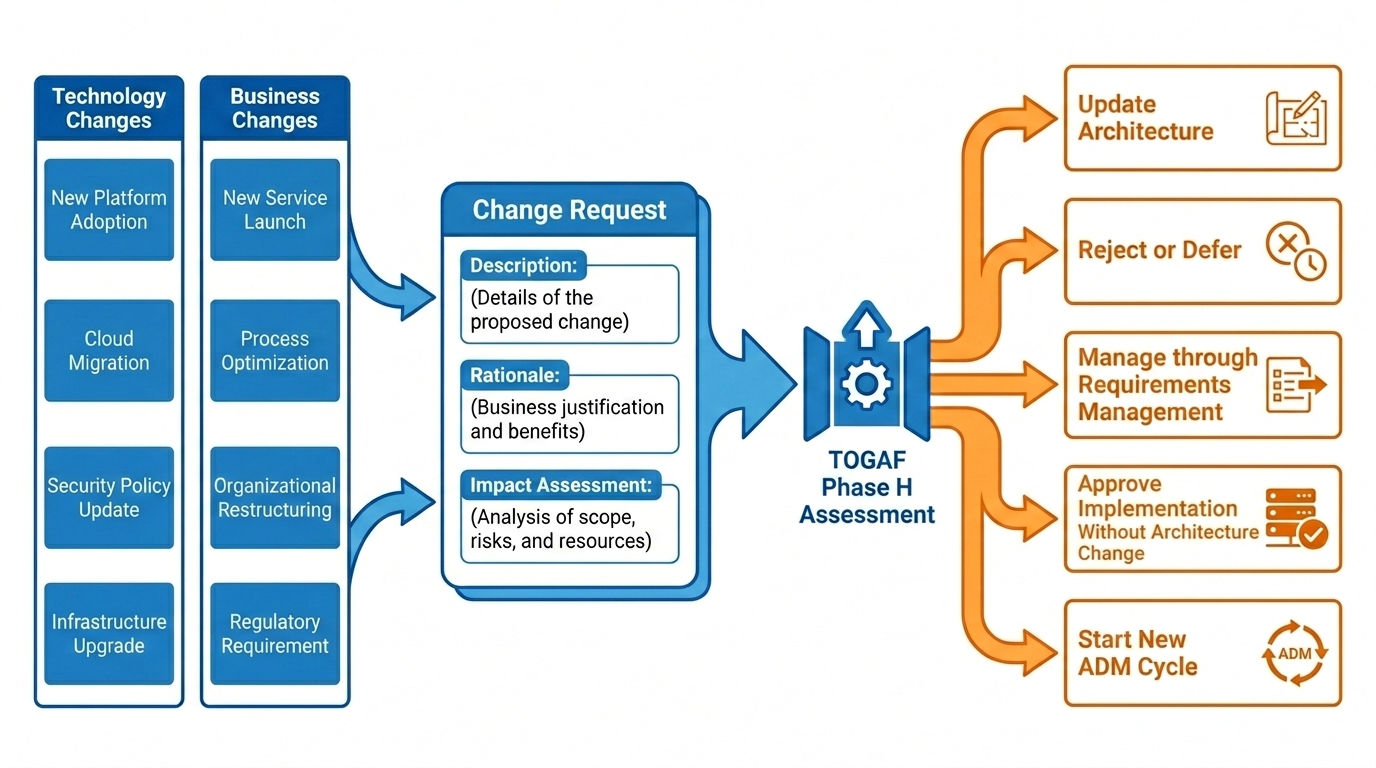
Change requests can come from technology changes or business changes.
| Source | Examples |
|---|---|
| Technology change | new technology announcement, IT asset management cost reduction initiative, technology withdrawal, outdated software, new vulnerability |
| Business change | new business development, business exception, innovation, strategic change, new stakeholder priorities |
These changes may create pressure to revisit the architecture, requirements, scope, or solution choices.
Change requests during ADM
Change requests can occur during different ADM phases, especially migration planning and implementation governance.
During Phase F: Migration Planning, change requests for the architecture capability may arise when completing the architecture development cycle and documenting lessons learned.
During Phase G: Implementation Governance, implementation projects may discover that the original architecture definition or requirements are not suitable or sufficient.
In those cases, implementation projects may:
- deviate from the suggested architectural approach
- request a scope extension
- request a solution change
- identify missing or insufficient requirements
Those situations can produce a change request.
Regardless of where the change request originates, it is assessed in Phase H: Architecture Change Management.
Typical content
A change request should include a clear description and rationale for the proposed change.
It should also include an impact assessment.
Typical content includes:
- change ID
- title
- requester
- description of the proposed change
- rationale for the change
- requirements references
- impact on stakeholder priorities
- affected ADM phases
- impact on the architecture
- recommendations for managing requirements
- repository reference number, if available
The repository reference number helps readers connect the change request to the facts stored in the change repository.
Why templates help
A template standardizes how change requests are captured, analyzed, and decided.
Templates make it easier to:
- compare change requests
- prioritize change requests
- assess impacts consistently
- support governance decisions
- keep a record of the rationale and decision
TOGAF provides a change request template in the TOGAF library.
Phase H decision
Phase H decides what happens next.
Possible outcomes include:
- update the architecture
- reject or defer the request
- manage the request through requirements management
- approve implementation without architecture change
- start a new ADM cycle
If the change requires new architecture work, a new Request for Architecture Work can kick off a further cycle of architecture work.
Exam note
- Change requests are the most important architectural input to Phase H.
- All change requests trigger change management.
- Change requests can come from both technology and business sources.
- A change request describes a deviation from the suggested architectural approach.
- Examples include scope changes, requirement changes, and solution changes.
- Change requests may be based on implementation learning or external factors such as business strategy change.
- A change request includes description, rationale, and impact assessment.
- The impact assessment may reference requirements, stakeholder priorities, affected ADM phases, and requirements management recommendations.
- A repository reference number helps connect the request to facts in the change repository.
- Change requests are assessed in Phase H to decide whether to update the architecture or start a new ADM cycle.