TL;DR
In Phase G, TOGAF can align with agile delivery by using enterprise architecture to guide products, product boundaries, constraints, and backlog direction across portfolio, project, and solution delivery levels.
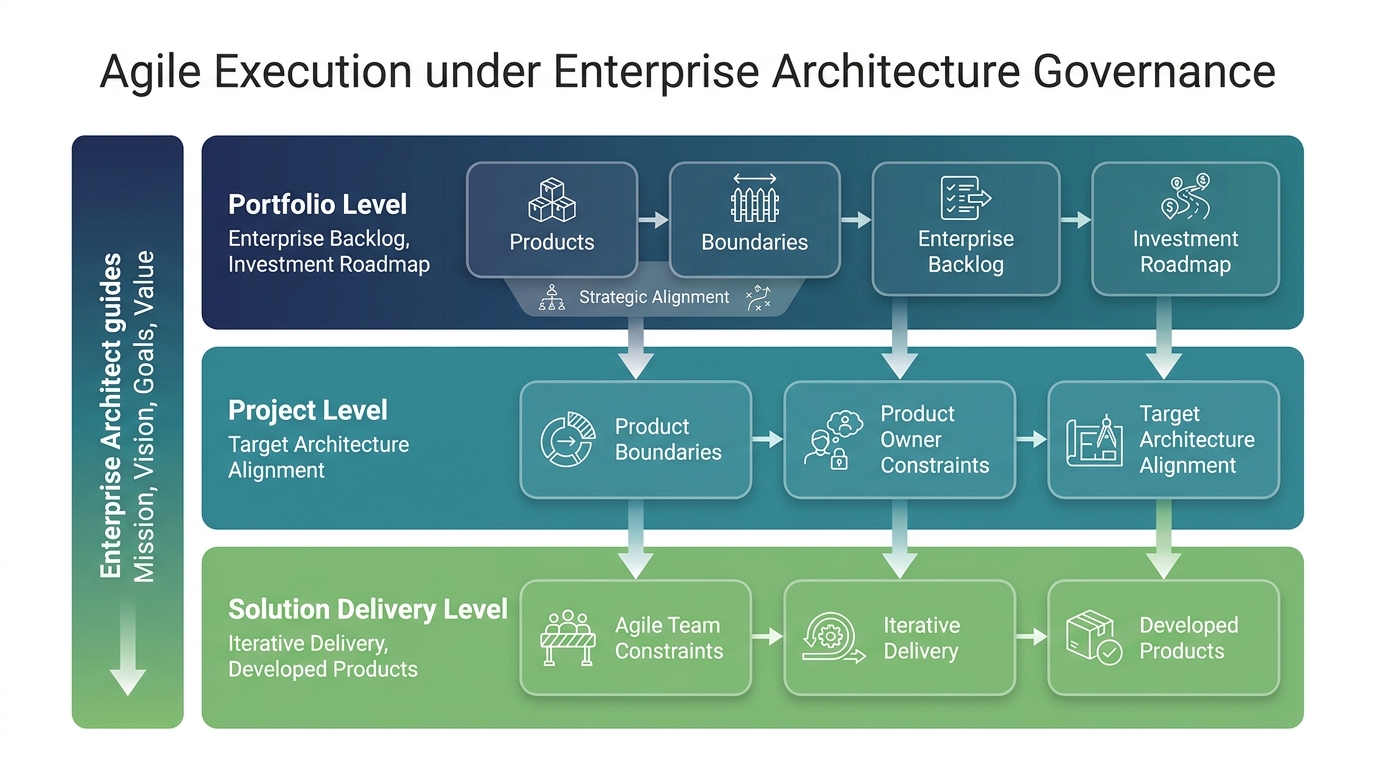
Agile in Phase G
Phase G: Implementation Governance is where the focus shifts toward execution of implementation projects.
This execution can work with agile development.
The role of enterprise architecture is not to replace agile delivery, but to guide it so that agile work still moves the enterprise toward the target architecture and investment roadmap.
Portfolio level
At the portfolio level, enterprise architecture identifies:
- the products needed
- the boundaries of those products
- the architecture constraints that shape delivery
- the enterprise backlog direction
This helps the organization decide where investment should go and which products are needed to realize enterprise value.
Project level
At the project level, the products and their boundaries are again made clear.
The Enterprise Architecture capability sets constraints for Product Owners so that product decisions remain aligned with:
- the target architecture
- stakeholder needs
- enterprise goals
- the investment roadmap
The Product Owner still manages product delivery, but does so within the architectural boundaries and constraints defined by the enterprise architecture.
Solution delivery level
At the solution delivery level, constraints are defined for agile teams.
These constraints are set in the context of the products being developed.
The purpose is to give agile teams enough freedom to deliver iteratively while still keeping implementation aligned with the architecture.
Role of the Enterprise Architect
In agile execution, the Enterprise Architect serves the stakeholders by guiding:
- mission
- vision
- goals
- product boundaries
- architecture constraints
- investment roadmap
The Enterprise Architect helps connect agile delivery with enterprise value.
Exam note
- TOGAF Phase G can align with agile implementation projects.
- At portfolio level, enterprise architecture identifies needed products and their boundaries.
- The EA capability sets constraints for Product Owners and helps define enterprise backlog direction.
- At project level, product boundaries and Product Owner constraints are clarified.
- At solution delivery level, constraints are defined for agile teams.
- The Enterprise Architect guides mission, vision, goals, and the investment roadmap.
- Enterprise architecture guides enterprise value during agile execution.