TL;DR
ADM is not a waterfall model. It is iterative over the whole process, between phases, and within phases. Each architecture project starts with Phase A, but the path through the remaining ADM phases is tailored to the purpose, scope, information needs, and value of the work.
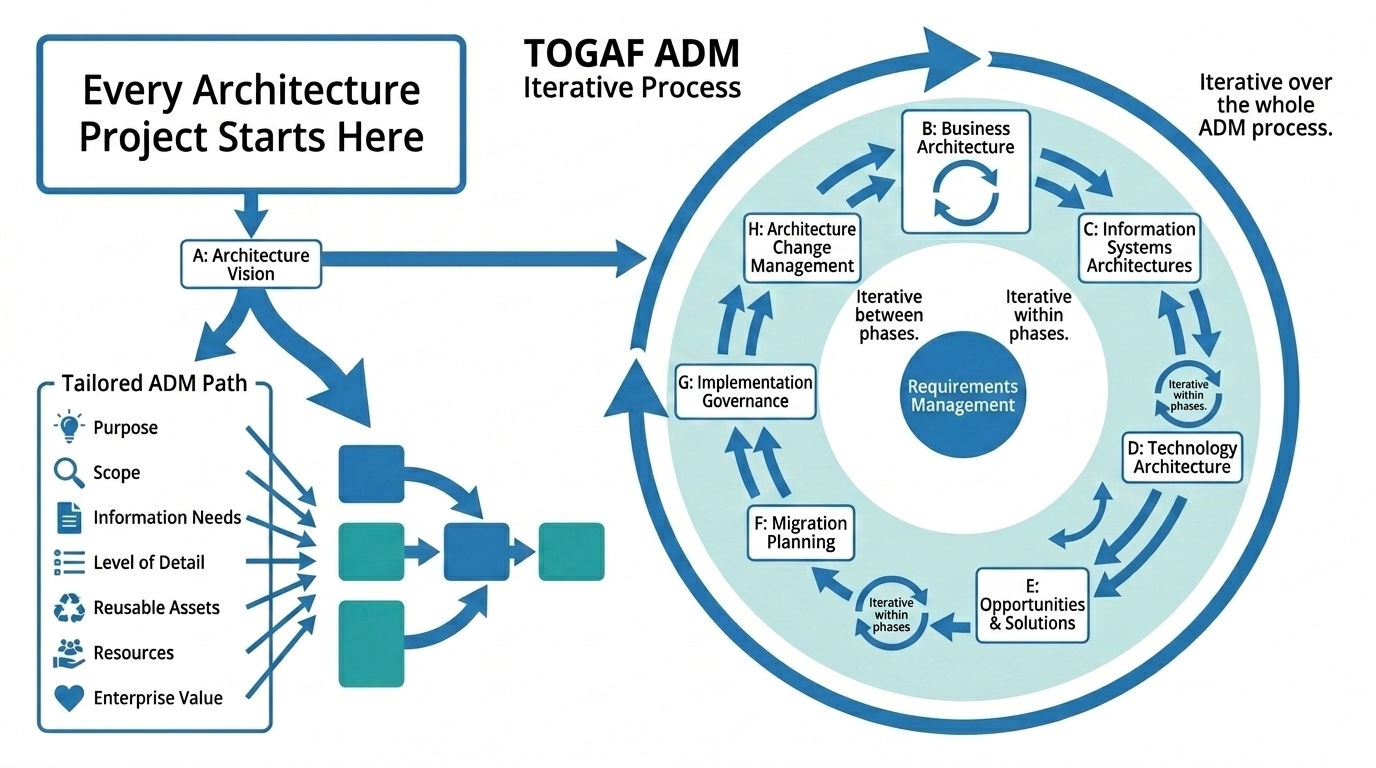
ADM is iterative
If you look at the ADM phases one after another, ADM can look like a waterfall model.
That is not how it is intended to work.
ADM is iterative in three ways:
- iterative over the whole process
- iterative between phases
- iterative within phases
This means ADM can be repeated, phases can be revisited, and steps inside a phase can be repeated or worked in parallel.
Iterative over the whole process
Iterative over the whole process means the enterprise can run through the entire ADM cycle more than once.
It can also run multiple ADM cycles at the same time.
This is useful when different architecture projects address different parts of the enterprise or different architecture problems.
Each cycle is still bounded by its own Request for Architecture Work.
Iterative between phases
Iterative between phases means the architecture team can move back and forth between ADM phases.
The team may:
- repeat a phase
- revisit an earlier phase
- work on multiple phases at the same time
- refine outputs as new information becomes available
This is common when business, data, application, and technology architecture work needs to be aligned.
Iterative within phases
Iterative within phases means the team can repeat steps inside a phase.
The team may also work on multiple steps inside a phase simultaneously.
This matters because architecture work often reveals new facts that affect earlier decisions.
Decisions before each iteration
Before each iteration, decide what kind of iteration is needed to address the problem at hand.
Each iteration involves decisions about:
- breadth of coverage
- level of detail
- time period
- architectural assets to reuse
- external assets to use
- resources and competencies available
- value to the enterprise
Breadth of coverage means deciding which organizations, business units, or architecture partitions are in scope.
Level of detail means deciding how deep the architecture work needs to go.
Time period means deciding how much time is available for the iteration and what future period the architecture must describe.
Why iterations are needed
Iterations are needed because enterprise architecture is complex.
They help reduce and manage that complexity.
Iterations are also needed because target architecture development is interdependent.
To develop a target architecture, the team must often consider:
- the entire architecture
- architecture gaps
- resulting work to close those gaps
- stakeholder priorities
- implementation and migration implications
These concerns influence each other, so architecture work rarely proceeds in a perfectly linear way.
ADM path depends on the architecture project
Every architecture project has a different purpose.
Because the project is commissioned through a Request for Architecture Work, the path through ADM depends on:
- the request
- the problem to be solved
- the information already available
- the required level of detail
- the architecture domains in scope
The only general exception is Phase A: Architecture Vision.
Each architecture project starts with Phase A to initiate and scope the architecture project.
Examples
If the goal is to standardize the Technology Architecture, the team may focus heavily on Phase D: Technology Architecture.
Phase B may be skipped or treated superficially if deep Business Architecture information is not needed.
If the goal is to harmonize the application landscape in a business area, the team should usually look closely at:
That is because the team needs to understand which applications support which processes, where process support is missing, and where new solutions could avoid system breaks.
In that scenario, Technology Architecture may play a smaller role.
Both scenarios still start with Phase A.
Tailoring the path
Architecture projects do not need to enter every ADM phase if the information is not needed or has already been produced.
ADM phases and steps can be:
- skipped
- executed simultaneously
- repeated
- performed at different levels of detail
- kept open while related information is produced
Multiple ADM phases may stay open at the same time to produce information with the required breadth, depth, time focus, and recency.
Exam note
- ADM is iterative, not waterfall.
- Iteration can occur over the whole process, between phases, and within phases.
- Before each iteration, define the purpose and scope.
- Iteration scope should consider breadth, depth, time period, reusable assets, resources, competencies, and enterprise value.
- Iterations help manage enterprise architecture complexity.
- Each architecture project starts with Phase A.
- After Phase A, each project can use an individual ADM path.
- ADM phases can be skipped, repeated, run concurrently, or kept open if needed.
- Iterations are driven by the information needs of the architecture project.