TL;DR
Interoperability is the ability to share information and services. In Phase E, interoperability requirements are consolidated and reconciled so the selected solutions can work together without avoidable conflicts.
Why it matters in Phase E
One Phase E activity is to consolidate and reconcile interoperability requirements.
The goal is to minimize interoperability conflicts between the solutions that will realize the target architecture.
This matters because Phase E starts selecting and shaping real solution options. Reused Solution Building Blocks, commercial products, and third-party services may each make different assumptions about integration, data, security, and service exchange.
What interoperability means
Interoperability
- The ability to share information and services.
- The ability of two or more systems or components to exchange and use information.
- The ability of systems to provide and receive services from other systems and use the services so interchanged to enable them to operate effectively together.
In TOGAF, interoperability is the ability to share:
- information
- services
It is broader than technical connectivity. Two systems may be connected technically and still fail to interoperate if their business meaning, data definitions, or service expectations do not align.
Types of interoperability
| Type | Core question |
|---|---|
| Operational or business interoperability | How do different parts of the enterprise work together at the business level? |
| Information interoperability | How is information shared, understood, and exchanged? |
| Technical interoperability | How are technical resources shared or connected? |
These types should be considered together. A technical interface is only useful when the business and information meaning are also clear.
Enterprise Application Integration
For Application Architecture, TOGAF recommends the concept of Enterprise Application Integration (EAI).
EAI separates integration concerns into layers.
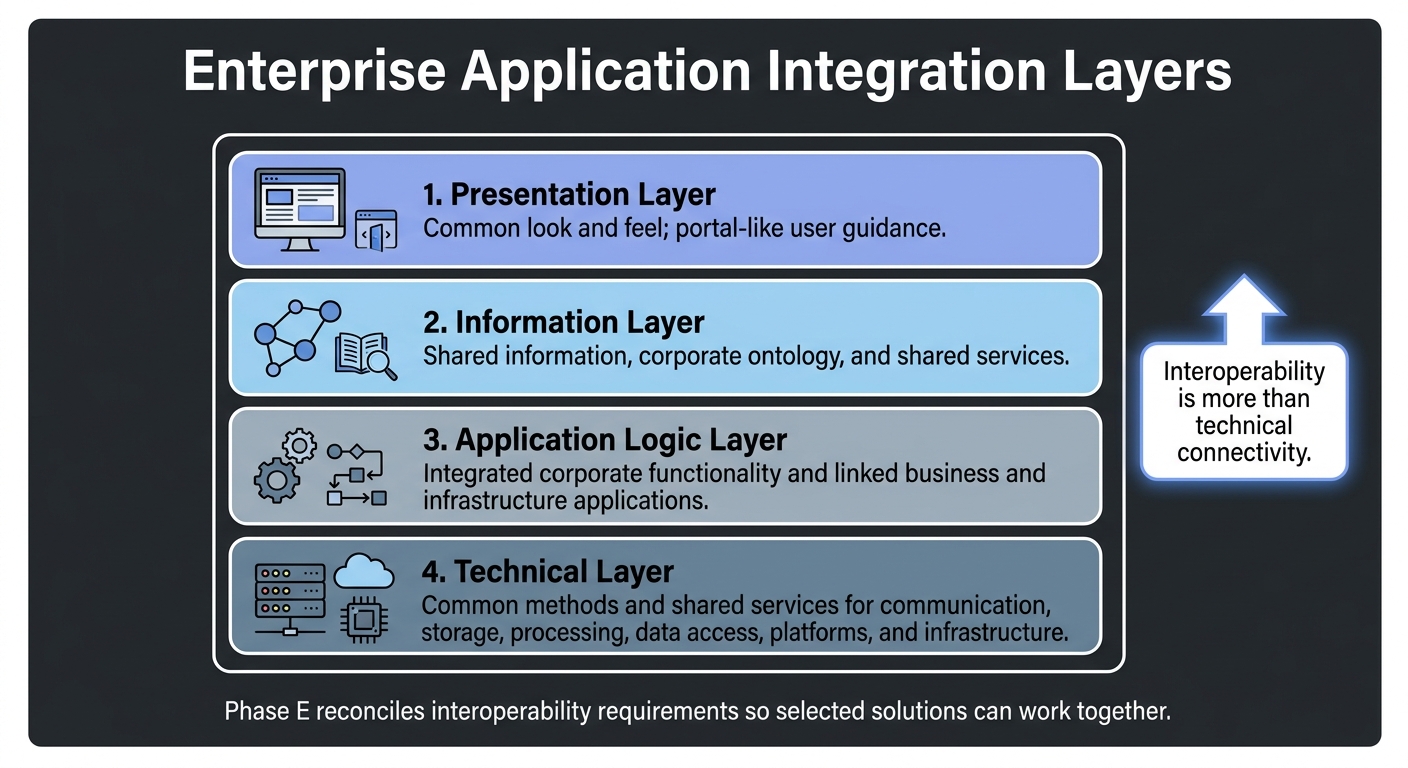
The four layers are presentation, information, application logic, and technical. This layering helps avoid treating interoperability as only an API or network problem.
Interoperability across the ADM
Interoperability is considered throughout the ADM cycle.
| ADM phase | Interoperability focus |
|---|---|
| Phase A: Architecture Vision | Use business scenarios to identify the nature and security considerations of information and service exchanges |
| Phase B: Business Architecture | Define information and service exchanges in business terms |
| Phase C: Information Systems Architectures | Detail the content of information exchanges with corporate data or information exchange models; specify how applications share information and services |
| Phase D: Technology Architecture | Specify the technical mechanisms that enable information and service exchanges |
| Phase E: Opportunities and Solutions | Select the actual solutions that realize interoperability and reconcile interoperability requirements |
| Phase F: Migration Planning | Plan the implementation of interoperability |
Practical checklist
When reconciling interoperability requirements, check:
- which information or services must be exchanged
- business meaning of the exchange
- data definitions and exchange models
- application responsibilities
- security considerations
- service ownership
- technical communication mechanisms
- dependency on reused Solution Building Blocks
- dependency on commercial products or third-party providers
Exam note
- Interoperability is the ability to share information and services.
- Phase E consolidates and reconciles interoperability requirements.
- Main goal: minimize interoperability conflicts between solutions.
- Interoperability can be operational/business, information, or technical.
- Enterprise Application Integration (EAI) is used to think about application integration layers.
- Interoperability is addressed across ADM from Phase A through Phase F.