TL;DR
The Enterprise Continuum classifies architecture and solution assets from generic to organization-specific. It helps architects understand what can be reused, specialized, generalized, and stored across enterprise repositories.
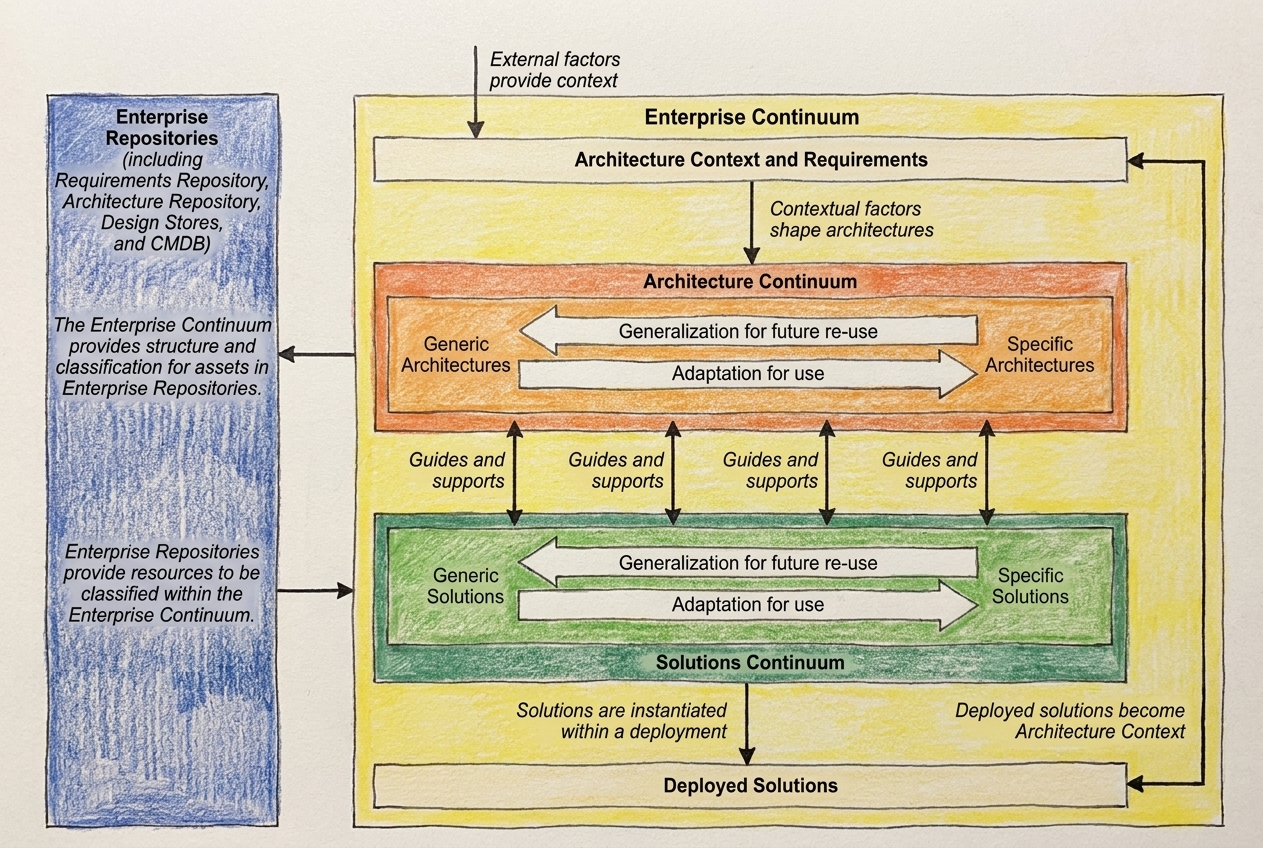
What it is
The Enterprise Continuum is a core concept in the TOGAF Standard.
Enterprise Continuum
A categorization mechanism for classifying architecture and Solution Building Blocks (SBBs) as they evolve from generic to specific applicability, or vice versa.
It provides a way to categorize architecture and solution assets held in enterprise repositories.
These repositories can include:
- Architecture Repository
- Architecture Requirements Repository
- design stores
- configuration management database
- other enterprise repositories
The Architecture Repository stores architecture outputs created through ADM.
The Enterprise Continuum provides the broader classification structure for those assets.
Purpose
The Enterprise Continuum gives architects a broader context for architecture assets.
It helps explain how generic assets can be reused and specialized to support the needs of a specific organization.
It can contain:
- architecture descriptions
- models
- building blocks
- patterns
- architecture viewpoints
- other reusable architecture artifacts
In simple terms, it helps architects understand whether an architecture or solution asset is very generic, very enterprise-specific, or somewhere in between.
Two complementary continuums
The Enterprise Continuum includes two complementary concepts:
- Architecture Continuum
- Solutions Continuum
The Architecture Continuum classifies architecture assets.
The Solutions Continuum classifies solution assets.
Solution Continuum
A categorization mechanism, with increasing detail and specialization, for the components and artifacts stored in the Solutions Landscape or Reference Library, which are part of the Architecture Repository.
They work together because architecture describes what is needed, while solutions describe how those needs are implemented.
Architecture Continuum
The Architecture Continuum shows the relationship from foundation or generic architecture elements to organization-specific architectures.
Architecture Continuum
A categorization mechanism, with increasing detail and specialization, for the components and artifacts stored in the Architecture Landscape or Reference Library, which are part of the Architecture Repository. It begins with foundational definitions such as reference models, core strategies, and basic building blocks, then spans to Industry Architectures and Organization-Specific Architecture.
It provides a consistent way to understand:
- generic rules
- architecture representations
- relationships between architecture assets
- traceability
- derivation relationships
- reuse opportunities
It is also useful for discovering commonality and eliminating unnecessary redundancy.
The Architecture Continuum structures architecture building blocks, or ABBs.
Architecture building blocks are reusable architecture assets.
Generic to specific
On the generic side of the continuum are architectures that can be reused across many organizations, industries, or business contexts.
These may include external reference models, architecture patterns, or broadly applicable architecture descriptions.
On the specific side are architectures tailored to the individual enterprise.
These are developed for the organization’s actual business needs, constraints, stakeholders, and operating model.
The enterprise can move in both directions:
- specialize a generic architecture to fit the enterprise
- generalize an enterprise-specific architecture so it can be reused later
Internal and external assets
Internal architecture and solution artifacts may come from previous architecture work.
Examples include:
- prior ADM deliverables
- reusable architecture building blocks
- solution building blocks
- organization-specific patterns
- lessons learned from implementation
External architecture and solution artifacts may come from outside the enterprise.
Examples include:
- industry reference models
- generic architecture patterns
- external standards
- vendor-neutral reusable models
- emerging best practices
Relationship to repositories
The Enterprise Continuum is not just one physical storage location.
It is a way of viewing and classifying assets across enterprise repositories.
The repositories store the assets.
The Enterprise Continuum helps classify them by level of generality and reuse.
In simple terms:
| Concept | Role |
|---|---|
| Architecture Repository | stores architecture assets and outputs |
| Enterprise Continuum | classifies assets from generic to organization-specific |
| Architecture Continuum | classifies reusable architecture assets and ABBs |
| Solutions Continuum | classifies reusable solution assets and SBBs |
Exam note
- The Enterprise Continuum classifies assets held in enterprise repositories.
- It provides broader context for architecture and solution assets.
- It explains how generic assets can be specialized for a specific enterprise.
- It includes the Architecture Continuum and the Solutions Continuum.
- The Architecture Continuum classifies architecture assets and architecture building blocks.
- The Solutions Continuum works similarly for solution assets and solution building blocks.
- Generic assets can be specialized for enterprise use.
- Enterprise-specific assets can be generalized for future reuse.
- The continuum helps discover commonality, support reuse, and reduce unnecessary redundancy.