TL;DR
Requirements Management continuously drives the ADM by identifying, storing, and distributing architecture requirements and requirement changes. The process manages requirements, while the ADM phases address, dispose of, or prioritize them.
Core idea
The ADM is continuously driven by Requirements Management.
Requirements Management is a dynamic process where requirements for enterprise architecture, and changes to those requirements, are:
- identified
- stored
- managed
- fed into relevant ADM phases
- fed out of relevant ADM phases
- carried between ADM cycles when needed
This is why Requirements Management sits at the center of the ADM cycle.
Process vs phase responsibility
Requirements Management manages requirements and requirement changes.
It ensures that relevant architecture requirements are available for use by each ADM phase.
However, the ADM phases are responsible for acting on the requirements.
| Responsibility | Owner |
|---|---|
| Manage requirements and requirement changes | Requirements Management |
| Make requirements available to phases | Requirements Management |
| Address requirements | relevant ADM phases |
| Dispose of requirements | relevant ADM phases |
| Prioritize requirements | relevant ADM phases |
| Assess architecture impact | relevant ADM phases |
In simple terms, Requirements Management keeps the requirement flow controlled, but architecture work happens in the ADM phases.
Single point of truth
The TOGAF Standard recommends using an Architecture Requirements Repository to record and manage architecture requirements.
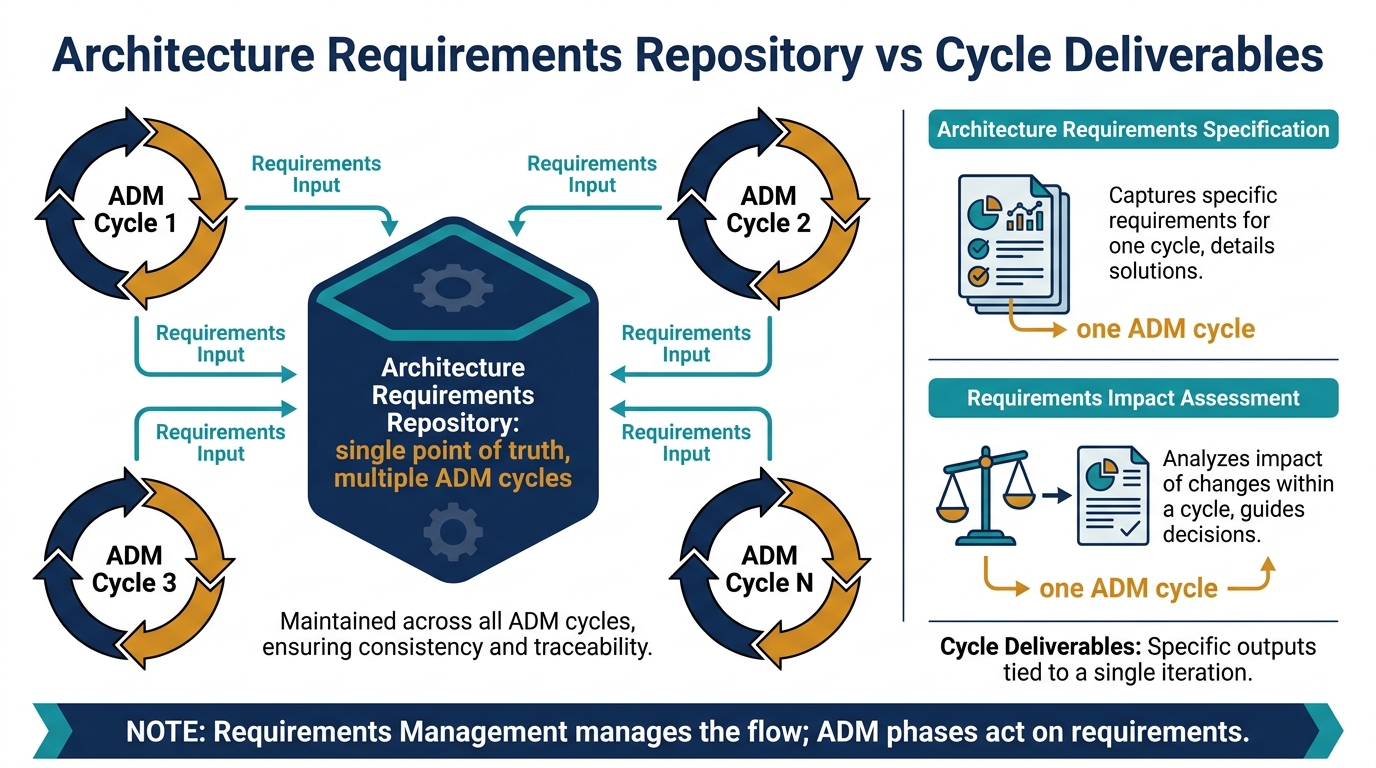
The repository acts as the single point of truth for architecture requirements.
It can hold requirements from multiple ADM cycles.
This makes it different from cycle-specific deliverables.
Repository vs deliverables
The Architecture Requirements Repository can contain requirements across multiple ADM cycles.
Other requirements deliverables are limited to one ADM cycle.
| Item | Scope |
|---|---|
| Architecture Requirements Repository | requirements across multiple ADM cycles |
| Architecture Requirements Specification | requirements for one ADM cycle |
| Requirements Impact Assessment | impact of requirement changes for one ADM cycle |
The repository is therefore broader and more persistent than the individual deliverables.
Exam note
- The ADM is continuously driven by Requirements Management.
- Requirements Management identifies, stores, and feeds requirements into and out of relevant ADM phases.
- It also manages changes to requirements.
- Relevant ADM phases address, dispose of, and prioritize requirements.
- Requirements Management ensures relevant architecture requirements are available to each phase.
- TOGAF recommends using an Architecture Requirements Repository as the single point of truth.
- The Architecture Requirements Repository can hold information from multiple ADM cycles.
- The Architecture Requirements Specification and Requirements Impact Assessment are limited to one ADM cycle.