TL;DR
Architecture Capability is the business capability that allows an enterprise to perform architecture work. It includes the structures, roles, skills, responsibilities, and processes needed to develop, use, govern, and sustain the target architecture.
What it is
Effective enterprise architecture requires an enterprise to establish and evolve an Architecture Capability.
Capability
An ability that an organization, person, or system possesses.
Architecture Capability is a business capability for architecture.
It enables the enterprise to carry out architecture activities in a disciplined and repeatable way.
Role
- The usual or expected behavior of an actor, or the part somebody or something plays in a particular process or event. An actor may have a number of roles.
- The part an individual plays in an organization and the contribution they make through the application of their skills, knowledge, experience, and abilities.
It consists of:
- organization structures
- roles
- skills
- responsibilities
- processes
- governance mechanisms
- management functions
The Architecture Capability is treated like an operational unit or business discipline within the enterprise.
It may use management functions such as:
- financial management
- service management
- resource management
- risk management
- opportunity management
Communications & Stakeholder Management
The management of needs of stakeholders of the Enterprise Architecture practice. It also manages the execution of communication between the practice and the stakeholders, and between the practice and the consumers of its services.
Operating model
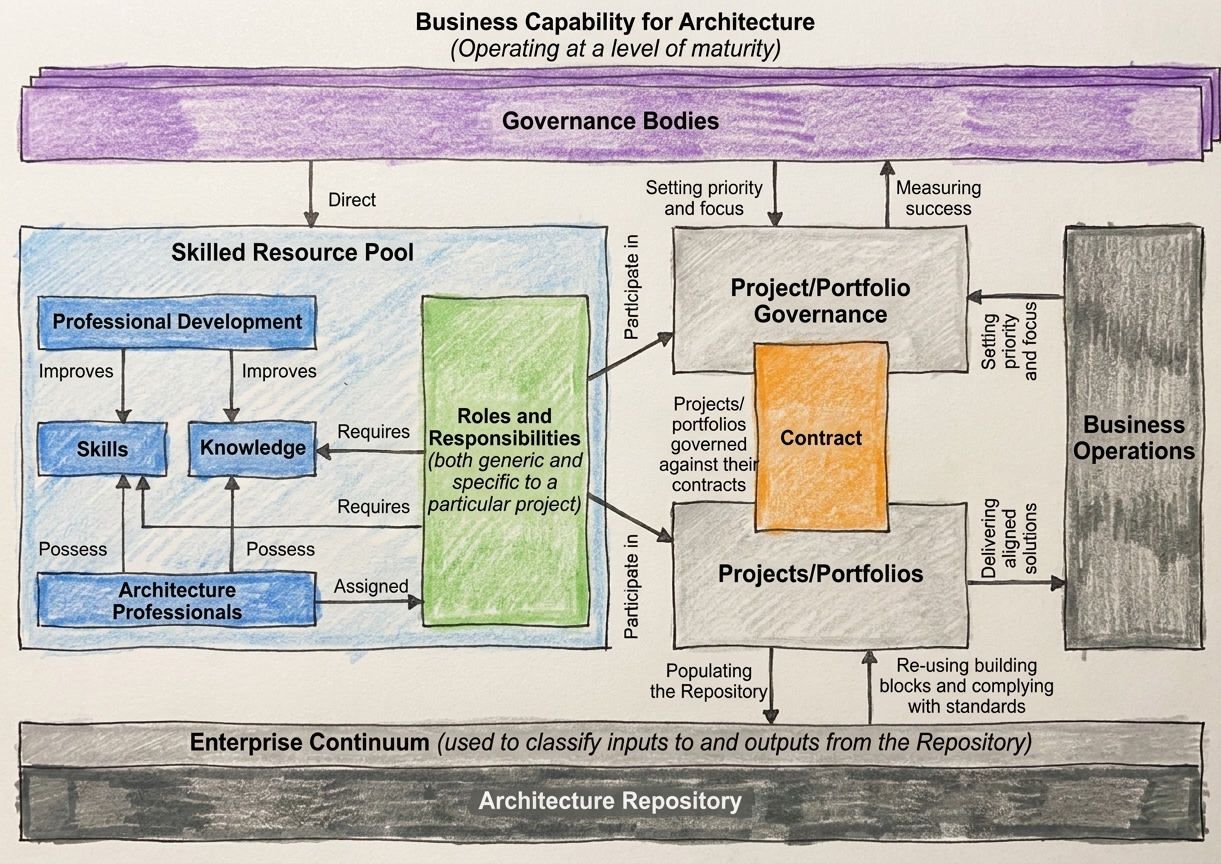
An Architecture Capability includes a skilled resource pool.
This resource pool contains architecture professionals with:
- skills
- knowledge
- roles
- responsibilities
Some architecture professionals participate in projects and portfolios to deliver aligned solutions for business operations.
During this work, they create architecture work products.
These work products are classified by the Enterprise Continuum as generic or enterprise-specific assets.
They are then stored in the Architecture Repository.
Other architecture professionals perform project and portfolio governance.
They govern projects and portfolios against their architecture contracts.
In all cases, the business sets the priority and focus of the projects.
Main goal
The main goal of Architecture Capability is to develop, use, and sustain the target architecture to govern change.
In other words, the Architecture Capability:
- describes the desired future state of the enterprise
- guides the change needed to reach that future state
- supports governance of architecture and implementation work
Purpose capabilities
TOGAF describes four purpose capabilities of architecture work.
They range from strategic architecture work to solution delivery support.
Architecture to support strategy
Architecture to support strategy focuses on change, synergies, and governance across multiple programs and portfolios.
It provides:
- end-to-end target architecture
- change roadmap
- identification of change initiatives
- support for portfolios and programs
- terms of reference
- identification of synergies
- governance of strategy execution
Typical characteristics:
| Dimension | Typical scope |
|---|---|
| Breadth | broad or narrow enterprise scope |
| Depth | low detail |
| Time period | 3 to 10 years |
| Stability | high-level and relatively stable |
Architecture to support portfolio
Architecture to support portfolio focuses on alignment, synergies, and governance for a single portfolio of projects.
It develops cross-functional, multiphase, and multi-project change initiatives.
It can be used to:
- identify projects
- set terms of reference for projects
- align project approaches
- identify project synergies
- govern project execution
Typical characteristics:
| Dimension | Typical scope |
|---|---|
| Breadth | single subject or project portfolio |
| Depth | low detail, but detailed enough to define project constraints |
| Time period | 2 to 5 years |
Architecture to support project
Architecture to support project focuses on integration for a single project.
It supports the enterprise’s project delivery method.
It can be used to:
- clarify project purpose and value
- identify requirements
- address synergy and future dependency
- assure compliance
- support integration and alignment between projects
Typical characteristics:
| Dimension | Typical scope |
|---|---|
| Breadth | narrow, focused on one project within a portfolio |
| Depth | detailed |
| Time period | 2 years or less |
Architecture to support solution delivery
Architecture to support solution delivery focuses on change governance for a single project or significant part of a project.
It supports solution deployment.
It can be used to:
- define how change will be designed and delivered
- identify constraints
- define architecture requirements for design
- define controls
- establish a governance framework for change
Typical characteristics:
| Dimension | Typical scope |
|---|---|
| Breadth | very narrow, usually one project or one significant project part |
| Depth | most detailed |
| Time period | 2 years or less |
Scoping the architecture work
When setting up an architecture project, always clarify the goal and purpose of the architecture to be developed.
Once the purpose is known, the architecture can be scoped using the four common scoping dimensions:
- breadth
- depth
- time period
- architecture domains
The purpose determines how much detail is needed and how broad the architecture work should be.
Developing the capability with ADM
Architecture Capability is itself a business capability.
That means it can be developed using the ADM.
There is no conceptual difference between using ADM to architect:
- architecture capability
- finance capability
- marketing capability
- any other business capability
When establishing Architecture Capability in the Preliminary Phase, the enterprise focuses on topics such as:
- architecture context
- business objectives
- architecture governance
- roles and responsibilities
- architecture processes
- architecture repository structure
- standards and methods
Benefits
A well-run Architecture Capability provides several benefits.
It supports:
- well-defined and effective governance
- transparency of accountability
- informed delegation of authority
- visibility for internal processes and external requirements
- increased internal and shareholder value
- reuse of processes, concepts, and components across business units
- proactive risk and opportunity management
- protection and reuse of existing architecture assets
Exam note
- Architecture Capability is a business capability for architecture.
- It consists of organization structures, roles, skills, responsibilities, and processes.
- It is treated like an operational unit within the enterprise.
- Its main goal is to develop, use, and sustain the target architecture to govern change.
- Architecture professionals create work products and govern projects and portfolios.
- The Enterprise Continuum classifies architecture work products.
- The Architecture Repository stores architecture work products.
- The business sets project priority and focus.
- The four purpose capabilities are architecture to support strategy, portfolio, project, and solution delivery.
- Architecture to support strategy usually covers 3 to 10 years.
- Architecture to support portfolio usually covers 2 to 5 years.
- Architecture to support project and solution delivery usually cover 2 years or less.
- Architecture Capability can itself be developed using ADM, especially through the Preliminary Phase.