TL;DR
In TOGAF, architecture is managed as time-based states: where you are now (Baseline), where you want to go (Target), and any approved intermediate steps (Transition Architectures).
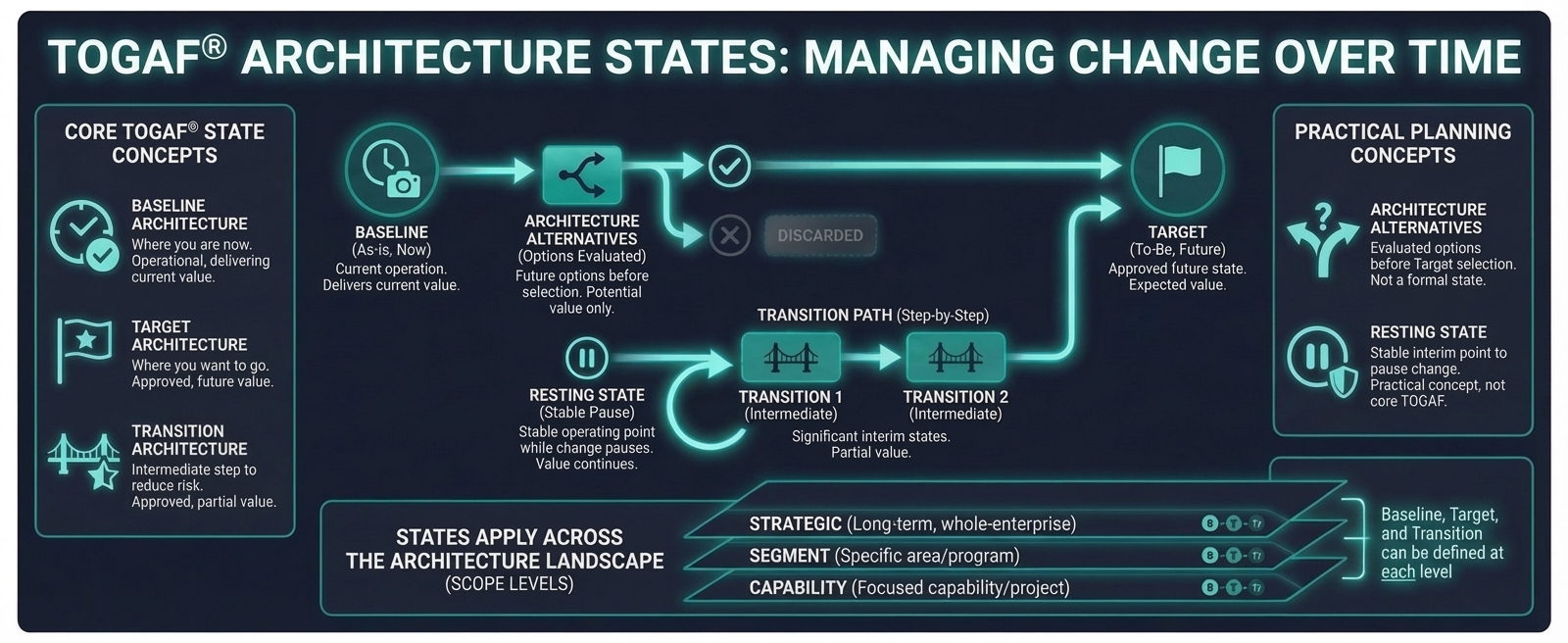
Why architecture states matter
Architecture is not static. It is a snapshot at a point in time.
Baseline
A specification that has been formally reviewed and agreed upon. It thereafter serves as the basis for further development or change and can be changed only through formal change control procedures or a type of procedure such as configuration management.
Target Architecture
The description of a future state of the architecture being developed for an organization. There may be several future states developed as a roadmap to show the evolution of the architecture to a target state.
Transition Architecture
A formal description of one state of the architecture at an architecturally significant point in time. One or more Transition Architectures may be used to describe the progression in time from the Baseline to the Target Architecture.
In TOGAF, states are differentiated by three things:
- point in time
- stakeholder approval status
- value realization
When organizations change, architects need to answer:
- What is the current state?
- What future state is approved?
- Do we need intermediate states to reduce risk?
Architecture states
| State | What it means | Stakeholder approval | Value realization |
|---|---|---|---|
| Baseline Architecture | Current state (as-is) of the enterprise architecture | already in operation | current value is already being delivered |
| Target Architecture | Approved future state (to-be) to be achieved | approved | expected future value |
| Transition Architecture | Intermediate future state on the path to target; an architecturally significant interim point in time | approved | partial value delivered earlier |
| Architecture Alternatives (practical planning term) | One or more future options evaluated before selecting a target | under evaluation | potential value only |
| Resting State (practical planning term) | A stable operating point where change can pause while value continues | accepted operating state | value continues even if change is paused |
Note
Baseline, Target, and Transition are the primary TOGAF architecture states used in planning and roadmaps. Architecture alternatives and resting state are practical planning concepts used by many teams.
Baseline and target are the core pair
These two states define the direction of change:
- Baseline: where we are now
- Target: where we want to be
Everything else supports movement between these two.
When to use transition architectures
You use transition states when “big bang” change is too risky or impractical.
Common reasons:
- budget or time constraints
- high delivery risk
- technical dependencies
- business readiness limits
A transition architecture should still be a usable, value-producing state — not just half-finished design work.
Architecture alternatives
Before finalizing a target architecture, teams often evaluate multiple candidate options.
Example options could differ by:
- cloud strategy
- integration pattern
- buy vs build application choices
- rollout model
After evaluation and stakeholder approval, one alternative becomes the target architecture.
Resting state
Sometimes programs pause due to budget cycles, mergers, regulation, or priority shifts.
A resting state defines a stable point where operations can continue and still deliver business value until change resumes.
Example: A bank completes Phase 1 of a core banking migration. The new payments module is live, but legacy lending still runs on the old system. This interim state is stable enough to operate while the next phase is planned and funded. That is a resting architecture.
Practical flow
flowchart LR
    B["Baseline<br/>(as-is)"]
    E{"Evaluate<br/>Candidates"}
    C1["Candidate A"]
    C2["Candidate B<br/>(approved)"]
    T["Target Architecture<br/>(to-be)"]
    TR1["Transition 1<br/>(interim stable state)"]
    TR2["Transition 2<br/>(interim stable state)"]

    B --> E
    E --> C1
    E --> C2
    C1 -. "not selected" .-> T
    C2 -->|"approved as target"| T
    B --> TR1 --> TR2 --> T
Step by step:
- Document Baseline Architecture.
- Define multiple architecture alternatives (if needed).
- Select and approve one as the Target Architecture.
- Plan one or more Transition Architectures.
- Move through transitions until target is reached.
In TOGAF’s Architecture Development Method (ADM), these states are reflected in baseline/target definition and migration roadmap planning.
Architecture states within the Architecture Landscape
TOGAF manages all of an enterprise’s architectures through the Architecture Landscape — a structured collection of all architectural descriptions across the enterprise.
The Landscape has three levels of scope:
| Level | What it covers |
|---|---|
| Strategic Architecture | Long-term, whole-enterprise direction; aligns with executive goals |
| Segment Architecture | A specific area or program within the enterprise; more detailed |
| Capability Architecture | A focused capability or project; most granular level |
Architecture states (Baseline, Target, Transition) apply at each of these levels. A Transition Architecture at the Segment level, for example, represents an intermediate step within one part of the enterprise, not necessarily the whole organization.
Exam note
- Baseline always exists.
- Target and Transition states may or may not exist for every initiative.
- There can be multiple transition architectures between baseline and target.
- Architecture alternatives are evaluated before choosing the target.
- Resting state is a practical concept, not a core TOGAF state term.
- The Architecture Landscape organizes architectures across three levels: Strategic, Segment, and Capability.