TL;DR
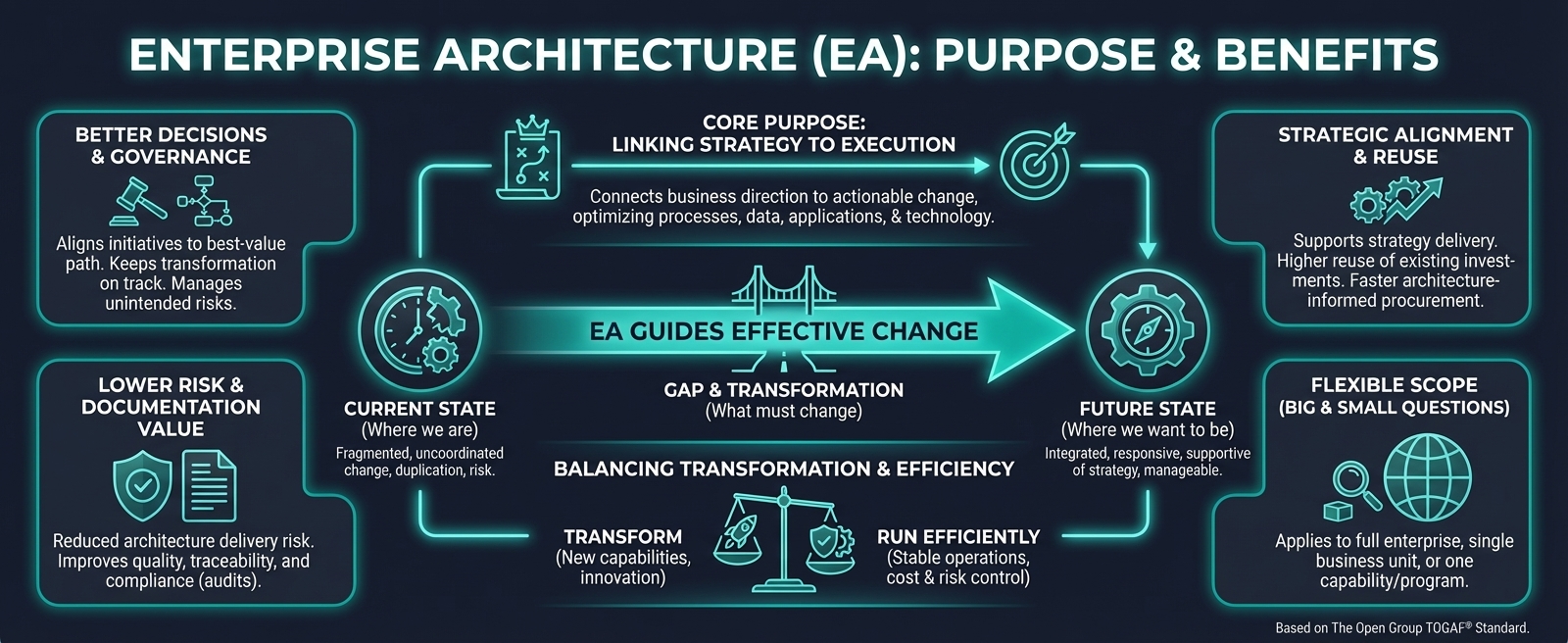
Enterprise Architecture (EA) exists to guide effective change. It connects business strategy to execution, defines what must change from current state to future state, and helps stakeholders govern that change for better outcomes with lower risk.
Why this topic matters
Enterprises are always changing, but uncoordinated change creates duplication, risk, and wasted investment.
EA gives a shared way to decide:
- what to change
- why it matters
- how to change without breaking operations
Core purpose of Enterprise Architecture
In TOGAF-aligned practice, EA is a framework for continuous change that links strategic direction to business value.
It helps optimize fragmented legacy processes, data, applications, and technology into a more integrated environment that is:
- responsive to business change
- supportive of strategy delivery
- manageable at enterprise scale
EA as a change guide: current, future, and gap
EA makes change actionable by describing:
- the current state (where we are now)
- the future state (where we want to be)
- the gap between them (what must change)
That gap defines the scope of change and drives priorities, roadmap decisions, and investment choices.
For related concepts, see:
Governance and stakeholder alignment
EA is not only a design activity. It is also a governance mechanism.
Stakeholders use EA to:
- align change initiatives to the best-value path
- keep transformation on track as conditions evolve
- manage the risk of unintended consequences across teams and systems
Balancing transformation and operational efficiency
A strong EA practice balances two needs that often conflict:
- transform the business (new capabilities, digital innovation)
- run the business efficiently (stable operations, cost and risk control)
EA enables business units to innovate while still fitting into an integrated enterprise strategy.
Documentation and compliance value
EA improves architecture documentation quality and traceability.
This supports audits, governance reviews, and regulatory compliance work, including situations where processes and data handling must be explained clearly to non-technical audiences.
Big questions and small questions
EA is used for enterprise-wide strategy decisions, but the same concepts also work at smaller scope.
Because “enterprise” is a scope choice, EA can be applied to:
- full-enterprise transformation
- one business unit
- one capability or program
The concepts remain the same; only scope and detail change.
Benefits summary
Common benefits from Enterprise Architecture practice:
- better strategic decision-making
- higher reuse of existing investments
- lower risk in future investments
- more effective digital transformation and operations
- faster and simpler architecture-informed procurement decisions
- better balance across conflicting business and technology demands
Practical note
Some benefits are easy to observe (for example, better decision quality and reduced architectural conflicts). Others, like exact monetary return, can be harder to measure directly.
Exam note
- The primary purpose of EA is to guide effective change to improve the enterprise.
- EA links strategy to execution through current state, future state, and gap analysis.
- EA supports both transformation and operational efficiency.
- EA is used by stakeholders to govern change and reduce unintended consequences.
- EA concepts apply at both large and small scopes.