TL;DR
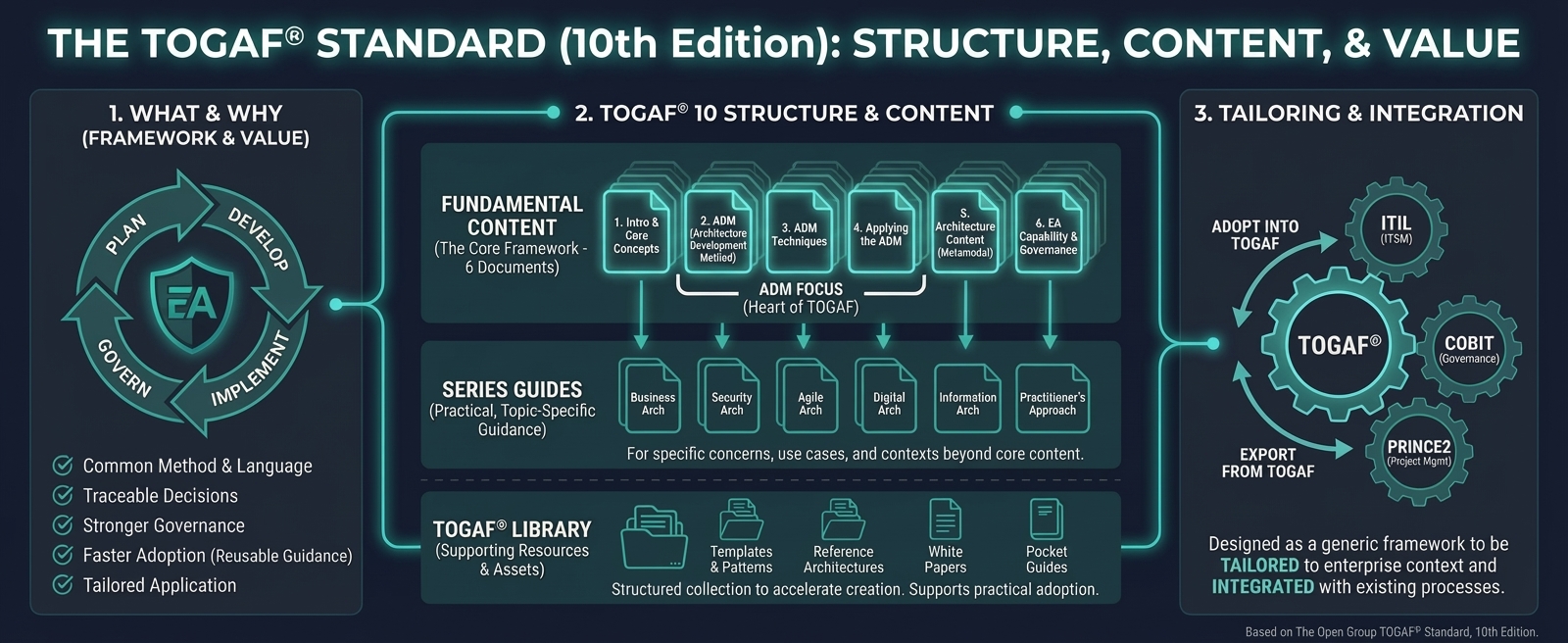
The TOGAF Standard is a best-practice enterprise architecture framework for planning, developing, implementing, and governing architecture change. In TOGAF 10, the standard is organized into Fundamental Content (six core documents) and Series Guides (practical, topic-specific guidance). The TOGAF Library is a separate supporting resource collection with templates, patterns, and reference material.
What is the TOGAF Standard?
The TOGAF Standard is an enterprise architecture framework used to develop and govern architecture in many contexts. It is developed through the collaborative efforts of The Open Group Architecture Forum.
Architecture Framework
A conceptual structure used to plan, develop, implement, govern, and sustain an architecture.
It describes:
- a standard cycle of change used to plan, develop, implement, govern, and sustain an architecture
- the building blocks an enterprise uses to deliver business services and information systems
What value does it add?
Using the TOGAF Standard helps teams work with a common architecture method and governance model:
- common method and language across teams
- traceable decisions from requirements to implementation
- stronger governance through defined roles, content, and checkpoints
- faster adoption via reusable guidance (Series Guides + Library)
- tailored application to fit enterprise context instead of one rigid template
This improves consistency and reduces architecture delivery risk.
Structure of TOGAF 10
The standard itself has two main parts. The TOGAF Library supports practical adoption.
flowchart TD
    T["TOGAF Standard"]
    FC["Fundamental Content<br/>(6 core documents)"]
    SG["TOGAF Series Guides<br/>(practical guidance)"]
    TL["TOGAF Library<br/>(supporting resources)"]

    T --> FC
    T --> SG
    TL -. "supports adoption of" .-> T
Fundamental Content
The core framework is covered by six documents:
| # | Document | What it covers |
|---|---|---|
| 1 | Introduction and Core Concepts | Overview of the TOGAF Standard, core concepts, and common definitions |
| 2 | Architecture Development Method (ADM) | The iterative approach for developing and managing the lifecycle of an enterprise architecture — the heart of TOGAF |
| 3 | ADM Techniques | A collection of techniques available for use in applying the TOGAF approach and the ADM |
| 4 | Applying the ADM | Guidelines for adapting the ADM to suit specific architectural contexts |
| 5 | Architecture Content | The TOGAF Content Framework — a structured metamodel for architectural artifacts and typical deliverables |
| 6 | Enterprise Architecture Capability and Governance | Organisation, processes, skills, roles, and responsibilities for an architecture function, plus the governance framework |
Note
Three of the six documents are dedicated to the ADM, reflecting its central importance in the TOGAF Standard.
TOGAF Series Guides
Series Guides provide practical guidance for specific concerns, use cases, and contexts beyond the core content.
They are designed for practitioners who need:
- further explanation on specific topics
- more detail than the fundamental content provides
- guidance on applying TOGAF in particular styles or situations
Example topics covered by Series Guides:
- Business Architecture
- Security Architecture
- Agile Architecture
- Digital Architecture
- Information Architecture
- A Practitioner’s Approach to Developing Enterprise Architecture Following the TOGAF ADM
Note
All documents in the TOGAF Standard — whether Fundamental Content or Series Guides — are free-standing but closely linked. You can use them independently while they reference each other as needed.
The TOGAF Library (supporting resources)
The TOGAF Library is a structured collection of additional resources that support practical use of the TOGAF Standard.
It includes:
- guidelines and templates
- patterns and reference architectures
- white papers and pocket guides
The library content can be leveraged to accelerate the creation of new architectures.
The TOGAF Library is part of The Open Group Library and maintained under the governance of The Open Group Architecture Forum.
Tailoring and integration with other frameworks
The TOGAF Standard is a generic framework designed to be tailored and integrated.
This works in two directions:
- Adopt into TOGAF — bring in elements or deliverables from other frameworks and use them with TOGAF
- Export from TOGAF — integrate TOGAF methods, deliverables, or elements into other frameworks
Common frameworks that synergise with TOGAF:
| Framework | Domain |
|---|---|
| ITIL | IT Service Management |
| COBIT | IT Governance |
| PRINCE2 | Project Management |
When adopting TOGAF alongside existing frameworks, you need to determine:
- which parts of TOGAF to use
- which parts of other frameworks to retain
- how these elements interact with each other
TOGAF should be tailored and integrated into an organisation’s existing processes and structures. However, it may also be used as a standalone framework.
What changed in TOGAF 10 (quick view)
Compared with TOGAF 9.2, TOGAF 10 emphasizes:
- modular structure (Fundamental Content + Series Guides)
- expanded practical guidance through Series Guides
- easier adoption by separating stable core concepts from fast-evolving guidance
Note
The Open Group publication for TOGAF 10 also notes that Technical Corrigendum 1 was applied in May 2025.
Exam note
- The TOGAF Standard is a best-practice enterprise architecture framework maintained by The Open Group.
- It comprises Fundamental Content (6 core documents) and Series Guides (practical guidance).
- The ADM is the heart of TOGAF — three of six fundamental documents are dedicated to it.
- The sixth fundamental document covers EA Capability and Governance (org, processes, skills, roles).
- The TOGAF Library provides additional templates, patterns, white papers, and reference architectures.
- TOGAF is designed to be tailored to an organisation and integrated with other frameworks (ITIL, COBIT, PRINCE2).
- All TOGAF documents are free-standing but closely linked.