TL;DR
Enterprise Architecture (EA) explains how a business and its technology fit together, and how both should evolve over time. TOGAF is the framework used to develop, plan, and govern that architecture.
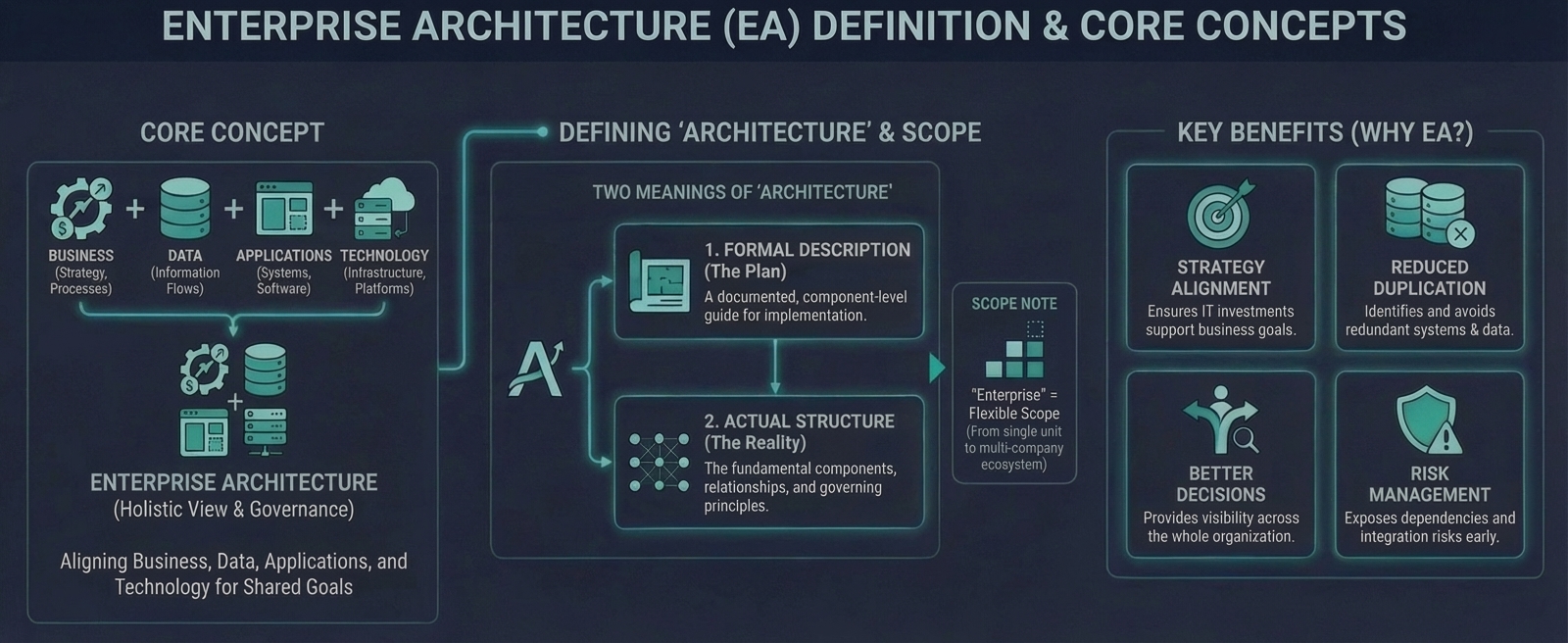
What is TOGAF? (quick context)
TOGAF is a framework used to develop and govern Enterprise Architecture; it is not an architecture itself.
If you want the structure and components of TOGAF 10, see The TOGAF Standard.
What does “enterprise” mean?
Enterprise
The highest level, typically, of description of an organization. It typically covers all missions and functions, and will often span multiple organizations.
In TOGAF context, an enterprise is any collection of organizations with common goals.
That can mean:
- one full company
- one business unit or division
- a holding company with multiple companies
- an ecosystem that includes partners, suppliers, and customers
So the word “enterprise” is about scope. You choose the scope based on your goals, responsibilities, and available resources.
What does “architecture” mean?
Architecture
- The fundamental concepts or properties of a system in its environment embodied in its elements, relationships, and in the principles of its design and evolution. Source: ISO/IEC/IEEE 42010:2011.
- The structure of components, their inter-relationships, and the principles and guidelines governing their design and evolution over time.
TOGAF uses both meanings in practice. When someone says “we built the architecture,” they are referring to the actual structure. When someone says “we need to create an architecture,” they are referring to the documented description or plan.
TOGAF puts strong focus on components, relationships, and design principles.
Put together: Enterprise Architecture
Enterprise Architecture describes how business and IT work together across the organization.
It usually covers:
- business capabilities and processes
- data and information flows
- applications
- technology platforms
- governance and decision rules
Think of EA as a “big-picture map” that helps people avoid local decisions that hurt the whole organization.
Why Enterprise Architecture?
Organizations invest in EA for several practical reasons:
- Strategy alignment — ensures IT investments support business goals, not just departmental priorities
- Reduced duplication — identifies overlapping systems and data before they become costly
- Better decisions — gives decision-makers visibility across business and IT before committing to change
- Risk management — exposes dependencies and integration risks early
- Faster change — a well-maintained architecture makes future changes cheaper and less disruptive
Quick example
A company wants to improve customer onboarding.
Without EA, teams may buy separate tools and create duplicate data.
With EA, teams align process design, application choices, integration, and governance before implementation.
Result: better decisions, less rework, and easier long-term change.
Exam note
- TOGAF is a framework, not an architecture. It defines how to develop and manage architecture.
- “Enterprise” refers to scope, not company size. A single business unit can be the enterprise.
- “Architecture” has two meanings: (1) a formal description or plan, and (2) the actual structure of a system.
- EA is not only about IT. It spans business, data, applications, and technology together.