TL;DR
TOGAF splits Enterprise Architecture into 4 linked domains: Business, Data, Application, and Technology. Business Architecture drives all the others. Together, the four domains give a complete view of how an enterprise works and how change should be designed.
Why architecture domains?
Enterprise Architecture is big.
Domains help break it into manageable parts without losing the full picture.
Architecture Domain
The architectural area being considered. TOGAF divides Enterprise Architecture into four primary architecture domains: business, data, application, and technology. Other domains, such as motivation, security, or governance, may span those four primary domains.
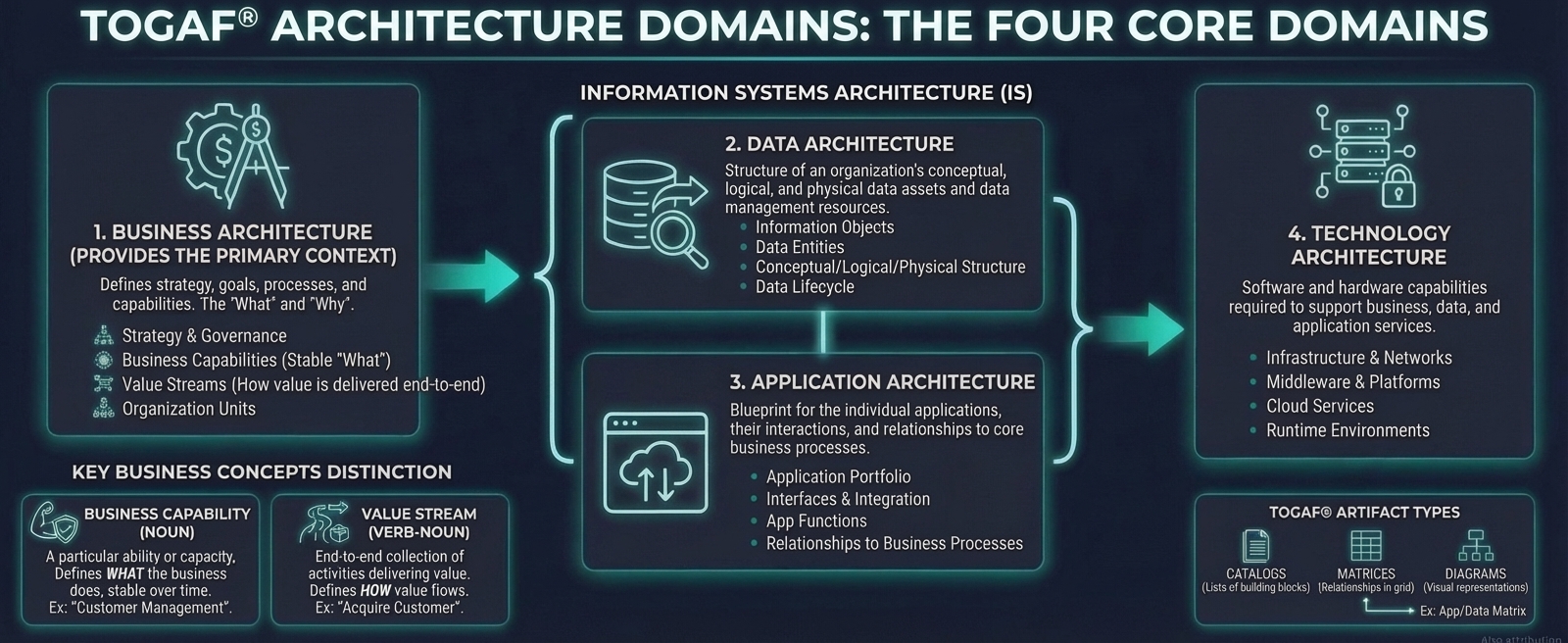
In TOGAF, the four core domains are:
- Business Architecture
- Data Architecture
- Application Architecture
- Technology Architecture
The 4 core domains (simple view)
Data Architecture
A description of the structure of the enterprise’s major types and sources of data, logical data assets, physical data assets, and data management resources.
Application Architecture
A description of the structure and interaction of the applications that provide key business capabilities and manage the data assets.
Technology Architecture
A description of the structure and interaction of the technology services and technology components.
| Domain | Main question it answers | Typical content |
|---|---|---|
| Business Architecture | What does the business do, and why? | strategy, governance, capabilities, value streams, processes, organization units |
| Data Architecture | What information do we need and manage? | information objects, data entities, conceptual/logical/physical data structure, data management resources |
| Application Architecture | Which systems support the business? | application portfolio, interfaces, application functions, app-to-process relationships |
| Technology Architecture | What technical foundation runs everything? | infrastructure, network, middleware, platforms, cloud services, runtime environments |
Two key Business Architecture concepts
Two concepts within Business Architecture are often confused but are distinct:
Business Architecture
A representation of holistic, multi-dimensional business views of capabilities, end-to-end value delivery, information, organizational structure, and the relationships among these business views and strategies, products, policies, processes, initiatives, and stakeholders. It relates business elements to business goals and elements of other domains.
Business Model
A model describing the rationale for how an enterprise creates, delivers, and captures value.
Business Capabilities
Business Capability
A particular ability that a business may possess or exchange to achieve a specific purpose.
A business capability is a particular ability or capacity that a business may possess or exchange to achieve a specific purpose.
- Describes what the business does — not how, why, or where
- Expressed as nouns: “Customer Management,” “Product Development,” “Order Fulfilment”
- Stable over time — capabilities remain relevant even as processes, technology, and org structure change around them
- Independent of organizational structure or IT systems
Value Streams
Value Stream
A representation of an end-to-end collection of activities that create an overall result for a customer, stakeholder, or end user.
A value stream is an end-to-end collection of value-adding activities that create an overall result for a customer, stakeholder, or end-user.
- Describes how value flows from a triggering event to a delivered outcome
- Expressed as verb-noun: “Acquire Customer,” “Fulfil Order,” “Resolve Complaint”
- Customer-centric — starts with a trigger and ends with value delivered to a stakeholder
- A higher-level abstraction than business processes; each stage may encompass many processes
How they relate
Note
Value streams and capabilities are different and complementary concepts in Business Architecture.
- Value streams show the context for why certain capabilities are needed at each stage
- Capabilities show what is required to successfully execute each stage of a value stream
- Mapping capabilities to value stream stages is a core Business Architecture practice
How the domains connect
In TOGAF 10 ADM practice, Business Architecture provides the primary context first, then Information Systems Architecture (Data + Application), then Technology Architecture. The work is iterative, not strictly one-way.
flowchart LR
    B["Business Architecture (Phase B)"]
    C["Information Systems Architecture (Phase C: Data + Application)"]
    T["Technology Architecture (Phase D)"]

    B --> C
    C --> T
    B -. "priorities and constraints" .-> T
    T -. "implementation feedback" .-> C
    C -. "business impact feedback" .-> B
- Business Architecture (Phase B) defines capabilities, value streams, and outcomes.
- Information Systems Architecture (Phase C) defines Data and Application together.
- Technology Architecture (Phase D) defines the technical platform that supports Phase C designs.
- Feedback loops across phases refine decisions as implementation realities emerge.
If Business Architecture changes, all other domains are affected. Technology changes may or may not affect Business Architecture, depending on business impact.
Domain groupings
TOGAF formally groups some domains together:
- Information Systems (IS) Architecture = Data + Application
This is the official TOGAF grouping used in the ADM. It captures how data is structured and how applications use that data to support business needs. - Technology Architecture stands separately alongside IS Architecture.
Important
The term “IT Architecture” is often used loosely in practice to mean Data + Application + Technology, but the official TOGAF term is “Information Systems Architecture” for the Data + Application grouping.
How domains map to ADM phases
The four domains directly correspond to phases in TOGAF’s Architecture Development Method (ADM):
| ADM Phase | Domain covered |
|---|---|
| Phase B | Business Architecture |
| Phase C | Information Systems Architecture (Data + Application) |
| Phase D | Technology Architecture |
This mapping helps you understand which domain work happens at which stage of an architecture development cycle.
Artifact types
In TOGAF, every domain is described using artifacts — architectural work products. The TOGAF Content Framework formally classifies all artifacts into exactly three types:
| Artifact type | Purpose | Example |
|---|---|---|
| Catalogs | Lists of building blocks — what exists in the architecture | Application Portfolio Catalog, Technology Standards Catalog |
| Matrices | Relationships between building blocks shown as a two-dimensional grid | Application/Data Matrix, Business Interaction Matrix |
| Diagrams | Visual representations of content and relationships | Value Chain Diagram, Platform Decomposition Diagram |
Note
You don’t create all artifacts for every project. You choose based on scope, stakeholder needs, and the questions you need to answer.
Architecture Building Blocks vs Solution Building Blocks
Artifacts describe the architecture in terms of building blocks — reusable components that make up the architecture. TOGAF defines two types:
| Type | What it defines | Technology stance | Example |
|---|---|---|---|
| Architecture Building Block (ABB) | What functionality is needed — abstract, logical, reusable | Technology-agnostic | ”Web Server,” “Identity Service,” “Customer Data Store” |
| Solution Building Block (SBB) | How that functionality is delivered — concrete, product-specific | Technology-specific (vendor/product-aware) | “Apache Tomcat,” “Azure Active Directory,” “Salesforce CRM” |
ABBs are defined during architecture design phases. SBBs are selected during implementation and migration planning, once vendors and products are decided.
Common artifacts by domain
Business artifacts
- business capability map
- value stream map
- value chain diagram
- organization map
- functional decomposition diagram
- business footprint diagram
Data artifacts
- conceptual data diagram
- logical data diagram
- data dissemination diagram
- data lifecycle diagram
- data entity/business function matrix
Application artifacts
- application portfolio catalog
- application communication diagram
- application/data matrix
- application/function matrix
- application/organization matrix
Technology artifacts
- technology portfolio catalog
- technology standards catalog
- platform decomposition diagram
- environments and locations diagram
- network computing diagram
Additional architecture views
You can also define additional views by combining the four core domains. These are composite views, not separate domains.
Common examples:
- Digital Architecture — how digital capabilities span business, data, applications, and technology
- Risk and Security Architecture — security controls and risk frameworks across all four domains
- Integration Architecture — how data flows and applications interoperate across the enterprise
- Cloud Architecture — technology and application decisions specific to cloud adoption
Note
These are perspectives on top of the four core domains, not replacements for them. You choose additional views based on scope, stakeholder needs, and program goals.
Practical example: Employee Onboarding
Business Architecture
You model the main process flow and identify the capabilities involved:
- Candidate accepted
- Employee record created → HR Management capability
- Access and devices provisioned → IT Provisioning capability
- Orientation completed → Workforce Development capability
- Employee fully productive
The value stream trigger is “Offer Accepted.” Each stage uses specific capabilities to deliver value to the new employee.
Data Architecture
You define key information objects:
- employee profile (role, location, manager, start date)
- access profile (systems, permission levels)
- asset assignment (laptop, phone, security tokens)
Application Architecture
You decide which applications support this flow and how they interact:
- HRMS — creates and holds the employee record
- Identity & Access Management — provisions system access based on role
- Service Desk — manages asset requests and hardware delivery
- Collaboration tools — set up email, calendar, and team spaces
These systems must exchange data automatically. This is the application interaction design.
Technology Architecture
You define the technical foundation:
- Cloud identity services (e.g. Azure AD or Okta) running the IAM platform
- Endpoint management service for device provisioning and policy enforcement
- Integration platform (API gateway or ESB) connecting HRMS to all downstream systems
- Secure network access for day-one connectivity
This gives a single end-to-end view from business capability to technical implementation.
Exam note
- TOGAF defines 4 primary domains: Business, Data, Application, Technology — often abbreviated BDAT.
- Business Architecture is the prerequisite for all other domains. It drives the definition of Data, Application, and Technology architectures.
- Data + Application are formally grouped as Information Systems (IS) Architecture — this is the correct TOGAF term.
- IS Architecture is covered in ADM Phase C; Technology Architecture in Phase D; Business Architecture in Phase B.
- Business Capability = what the business does (stable, noun-form, technology-independent).
- Value Stream = how value flows end-to-end to a stakeholder (triggered by an event, verb-noun form). Not the same as a capability.
- TOGAF artifacts have three formal types: Catalogs, Matrices, and Diagrams.
- ABBs are abstract and technology-agnostic. SBBs are concrete and product/vendor-specific.
- Domains must be linked; isolated domain views lead to weak decisions.
Enterprise Architecture is easiest to understand when you view it through domains.
The value is not only in documenting each domain, but in linking them — starting from Business — so that every IT decision traces back to a business need.