TL;DR
ADM is not a linear waterfall process. It is a logical method for developing architecture knowledge, where each phase consumes inputs, produces outputs, and passes or refines information across other ADM phases.
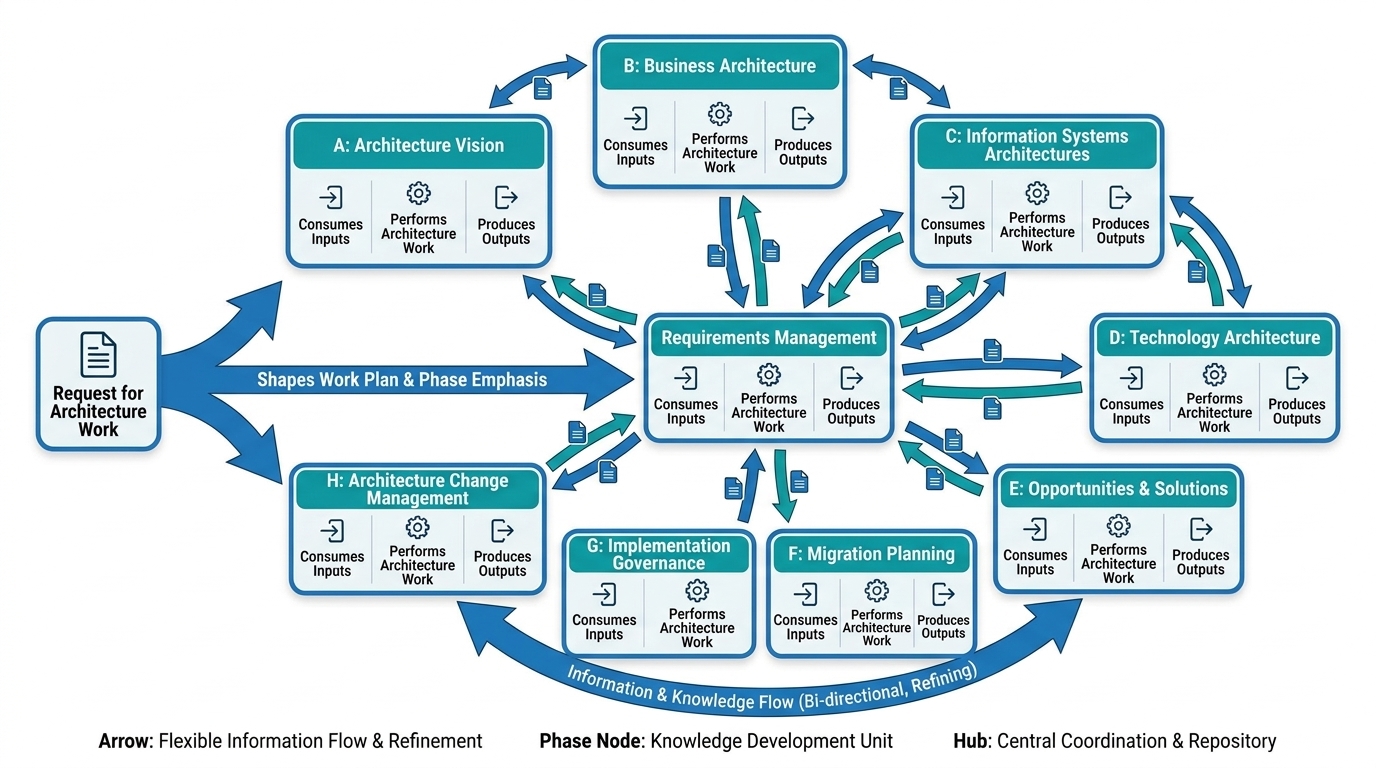
ADM is not a process sequence
The ADM phase diagram is often misunderstood.
It can look like a linear sequence, but ADM is not a waterfall process.
ADM is a logical method for developing knowledge.
It groups key activities together so the relationship between activities and the information flow between them can be understood.
The crop circle diagram
The TOGAF crop circle diagram is a stylized path.
It demonstrates essential information flow between ADM phases.
It should not be understood as:
- a strict process model
- a required activity sequence
- a waterfall lifecycle
- proof that every phase must be completed in order
The diagram helps explain what information is produced and consumed, not exactly how every team must work day to day.
How information flows
Each ADM phase exists because it produces an essential output needed to develop the architecture.
For each phase, TOGAF suggests the inputs needed to create that output.
In every ADM phase, the Enterprise Architect:
- consumes inputs
- performs architecture work
- produces outputs
The output of one phase can become the input of a later phase.
The output of one phase can also be updated, refined, or detailed in a later phase.
This creates information flow across the ADM.
Outputs evolve
Architecture outputs do not always stay fixed after their first creation.
They may be:
- reused in later phases
- refined with new detail
- updated because new facts are discovered
- adjusted because requirements change
- expanded because a later phase needs more precision
This is one reason ADM is iterative.
Work plan depends on the request
The work plan of an enterprise architecture team depends on the problem and development task defined in the Request for Architecture Work.
Each request can require:
- a distinct ADM path
- different phase emphasis
- different outputs
- different levels of detail
- different reuse of existing architecture assets
This reinforces the point that ADM is a tailorable method, not a fixed process script.
Exam note
- ADM is not a linear waterfall process.
- ADM is a logical method for developing architecture knowledge.
- The crop circle diagram shows essential information flow, not a mandatory process sequence.
- Each ADM phase consumes inputs and produces outputs.
- Outputs from one phase can become inputs to later phases.
- Outputs can be updated or detailed in later phases.
- The architecture team’s work plan depends on the Request for Architecture Work.
- Each request can require a distinct ADM path and different outputs.