TL;DR
Phase H monitors the delivered architecture, tracks value realization, manages risk, analyzes architecture performance, develops change requirements, runs governance, and activates the right change process when action is needed.
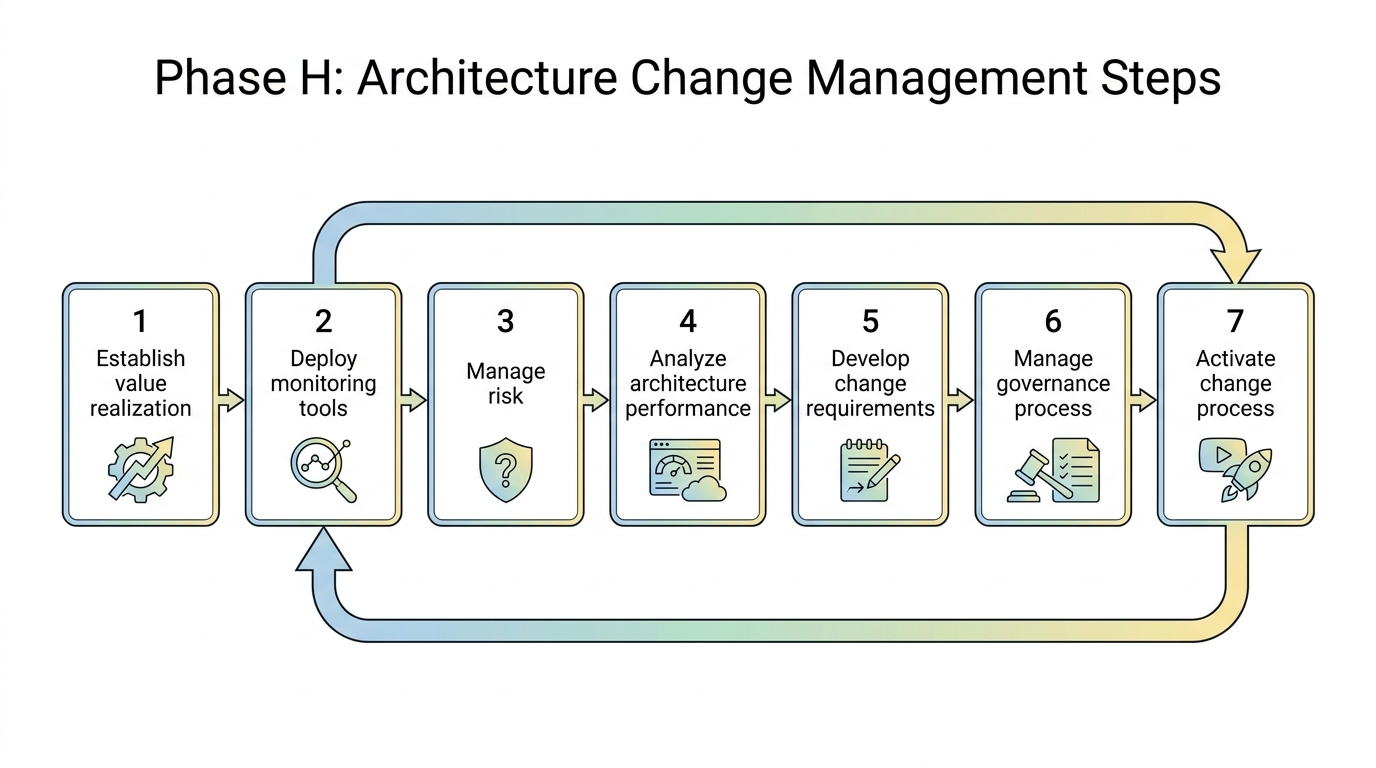
Step-by-step flow
Phase H has seven practical steps.
- Establish value realization.
- Deploy monitoring tools.
- Manage risk.
- Provide analysis for architecture change management.
- Develop change requirements to meet performance targets.
- Manage the governance process.
- Activate the process to implement change.
1) Establish value realization
The first step is to ensure that the architecture achieves its original target business value.
To do this, establish a value realization process.
The point is simple: make sure the enterprise actually gets the value promised in the Architecture Vision and communicate that value to stakeholders.
Example:
If the architecture decision was to shut down an application, the value is not fully realized just because the application is no longer used.
The organization may also need to:
- dismantle or reuse the infrastructure
- terminate license agreements
- reduce support costs
- confirm that the expected savings are actually achieved
2) Deploy monitoring tools
Deploy and apply monitoring tools to watch for changes that could affect the baseline architecture.
Monitoring should cover:
- capability
- maturity
- business change
- technology change
- quality of service
- performance
- usage
- realized business value
Business value can be tracked using investment appraisal methods and value metrics linked to business objectives.
The goal is to see whether the architecture continues to perform as expected and whether external or internal changes create pressure for architecture change.
3) Manage risk
Phase H uses monitoring to identify and manage risks.
Examples:
- software versions become outdated
- a new security vulnerability is discovered
- a license model changes
- usage patterns create new capacity risks
- technology support timelines change
When these risks appear, the Enterprise Architect reviews the architecture and informs relevant stakeholders.
For example, a changed license model may create a risk of license violations. Phase H should surface and control that risk.
4) Provide analysis for architecture change management
Analyze the performance of the architecture.
This can include enterprise architecture performance reviews with service management.
The key question is whether changes are necessary because the architecture is underperforming or no longer meeting requirements.
Use gap analysis to compare expected and actual performance.
Ask:
- Is the delivered architecture performing according to requirements?
- Is the architecture delivering the promised value?
- Are changes needed to reach performance goals?
- Does a change request require an architecture change?
- What impact would the change have on the architecture?
The most important part of this step is assessing change requests and ensuring adherence to architecture governance.
5) Develop change requirements to meet performance targets
If the architecture is not delivering the value or performance it promised, develop change requirements.
These change requirements should target the specific shortfall.
The recommendation may lead to:
- a minor change
- a larger architecture update
- a new target architecture
- a new ADM cycle
The intent is not change for its own sake. The change should help the architecture meet its performance and value targets.
6) Manage the governance process
Ensure that the architecture governance framework is executed.
This includes arranging Architecture Board meetings to decide how changes should be handled.
The Architecture Board may decide whether to:
- approve the change
- reject the change
- defer the change
- request more analysis
- require a new ADM cycle
This step keeps change decisions visible, controlled, and aligned with governance rules.
7) Activate the process to implement change
Once a change is approved, decide how it should be implemented.
If the change requires new architecture development or redevelopment, produce a new Request for Architecture Work to start a new ADM cycle.
If the change can be implemented without changing the architecture, give approval to the implementation team to deliver the change.
This step turns architecture change management into concrete action.
Exam note
- Phase H has seven steps.
- It starts by establishing value realization.
- Monitoring tools track capability, maturity, business change, technology change, quality of service, performance, usage, and business value.
- Phase H manages risks such as outdated software, vulnerabilities, license changes, and architecture performance issues.
- Architecture performance analysis checks whether the delivered architecture meets requirements and value targets.
- Change requests are assessed for architecture impact and governance compliance.
- Change requirements are developed when the architecture is not meeting performance or value targets.
- The Architecture Board is used to manage governance decisions.
- A major change can trigger a new Request for Architecture Work and a new ADM cycle.
- A smaller change may be sent directly to implementation if it does not require architecture redevelopment.